 YALA
Yala's Blue-tailed Bee-eater and the Flocks That Follow Your Jeep
You've probably heard that Yala's bee-eaters follow jeeps because they're curious about tourists. We checked. They couldn't care less about you. They care about the insects your jeep is kicking up out of the dust.
That distinction matters, because once you understand it, the whole blurry streak-of-green-and-blue show overhead starts making sense.
What You're Actually Looking At
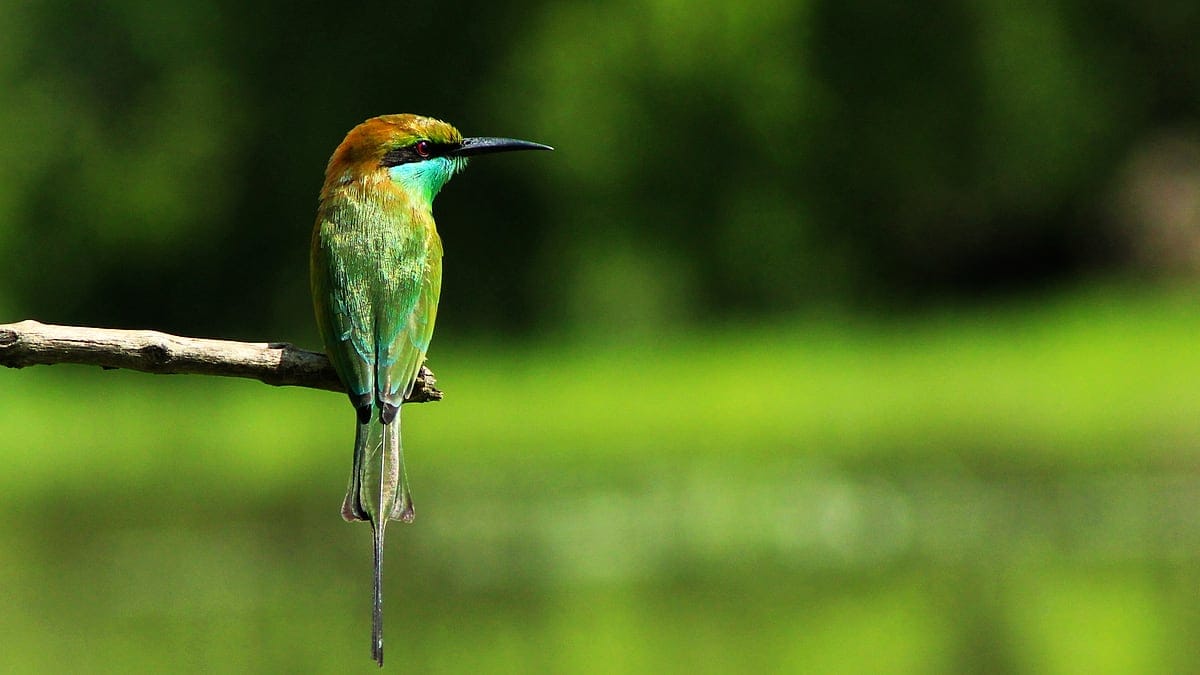
The blue-tailed bee-eater (Merops philippinus) is the long-tailed, electric-green bird you'll see slicing low over open ground near water, usually in groups rather than alone. It has the classic bee-eater silhouette: slim body, downcurved bill, and two elongated central tail feathers that trail behind it like a pennant. The throat is a warm chestnut-to-yellow patch, the eye stripe is black, and in good light the rump and tail show the blue wash that gives the species its name.
It's one of several bee-eater species recorded in Sri Lanka, and the one most associated with open, water-adjacent country, which describes a large share of Yala's terrain. The park's grasslands, tank edges and scrub clearings near waterholes are exactly the kind of open habitat this species prefers across its entire range, from India through Southeast Asia.
Why They Gather on the Jeep Tracks Specifically
This is the detail that surprises most first-time visitors. Bee-eaters aren't randomly scattered through the park. They cluster disproportionately along the sandy jeep tracks, particularly in the hour or two after a vehicle has passed through.
The mechanism is simple and has nothing to do with the vehicles themselves. Jeep tyres disturb loose sand and low vegetation, flushing grasshoppers, dragonflies and small bees into the air. Bee-eaters are aerial hawkers: they catch prey on the wing, often from a low perch, then return to the same perch to beat the insect against a branch before swallowing it. A disturbed verge is a free buffet, and the birds have clearly learned to associate dust clouds with food, the same way egrets learn to follow grazing buffalo.
So when you see a loose flock lift off a dead branch and scatter into acrobatic loops just after your driver pulls away from a junction, that's not a greeting. That's a feeding opportunity they've been waiting for.
Colonial Nesters, Seasonal Visitors
Here's where the species gets genuinely interesting beyond the obvious photo opportunity. Blue-tailed bee-eaters are colonial breeders, but they don't nest in trees. They excavate tunnels, sometimes close to a metre deep, into loamy sand banks, usually along river valleys. Sri Lanka sits at the edge of a much larger range stretching across South and Southeast Asia, and many populations here are migratory rather than fully resident, arriving and departing with the seasons rather than holding territory year-round.
In practice this means the bee-eater flocks you see in Yala are not a fixed, constant population. Numbers build noticeably from around August through to April, when migrant birds supplement whatever locally breeding groups are present, then thin out again as the migratory contingent moves on. We'd flag this as a general seasonal pattern rather than a precise calendar: exact arrival and departure dates shift year to year with monsoon timing, and we haven't found DWC data pinning down exact weekly counts for Yala specifically. If you're planning a birding-focused visit, the broader seasonal context in When to Visit Yala is worth reading alongside this.
Nesting itself tends to happen away from the main jeep-track circuits, in sandier cut banks near watercourses, so visitors are far more likely to witness the feeding flocks than the breeding colonies. That's not a loss. The feeding behaviour is, if anything, more dynamic to watch: synchronized aerobatics, constant chattering calls, and the characteristic looping flight path that brings a bird back to almost the exact perch it left.
Where to Watch Them in Yala
Block I's jeep tracks around the open grassland stretches near Katagamuwa and the areas bordering the tank systems are reliable spots, precisely because they combine two things bee-eaters want: open sky for aerial hunting and a steady stream of vehicle traffic disturbing insects at ground level. Early morning safaris, when insect activity rises with the first heat and traffic is already moving along the main circuit, tend to produce the busiest flocks.
They also gather readily around the park's tank margins and lagoon edges, where insect density is naturally higher thanks to standing water. If you're combining a bee-eater watch with broader wetland birding, the habitat overlaps with what's covered in Yala Lagoon and Coastal Birdlife.
One practical tip: don't expect a static sighting. These are fast, low, looping fliers that rarely hold still for more than a few seconds on open perches. A flock strung along a dead thorn branch beside the track, lifting in unison and scattering after insects, then regrouping on the same branch, is the signature view. Binoculars help more here than a long lens, because the behaviour is the story as much as the plumage.
Telling Them Apart From Yala's Other Bee-eaters
Sri Lanka hosts more than one bee-eater species, and it's easy to lump them together at a glance. The blue-tailed bee-eater is larger and longer-tailed than the little green bee-eater that's common in drier scrub, and it shows that distinctive blue rump and tail wash that the smaller species lacks. The chestnut-headed bee-eater, more of a forest-edge bird, has a solid rufous crown rather than the sharper eye-stripe pattern. If you're trying to separate them in the field, the habitat is often the quickest clue: open track and water-edge flocks skew heavily toward blue-tailed, while denser scrub sightings are more likely the little green bee-eater.
None of this requires expert-level birding to appreciate. The flocks are loud, visible, and genuinely easy to enjoy even from a moving jeep, which is more than can be said for most of Yala's shier residents.
Sources
- Wikipedia: "Blue-tailed bee-eater", https://en.wikipedia.org/wiki/Blue-tailed_bee-eater
- Department of Wildlife Conservation Sri Lanka
Ready to see it for yourself?
Book a safari