 YALA
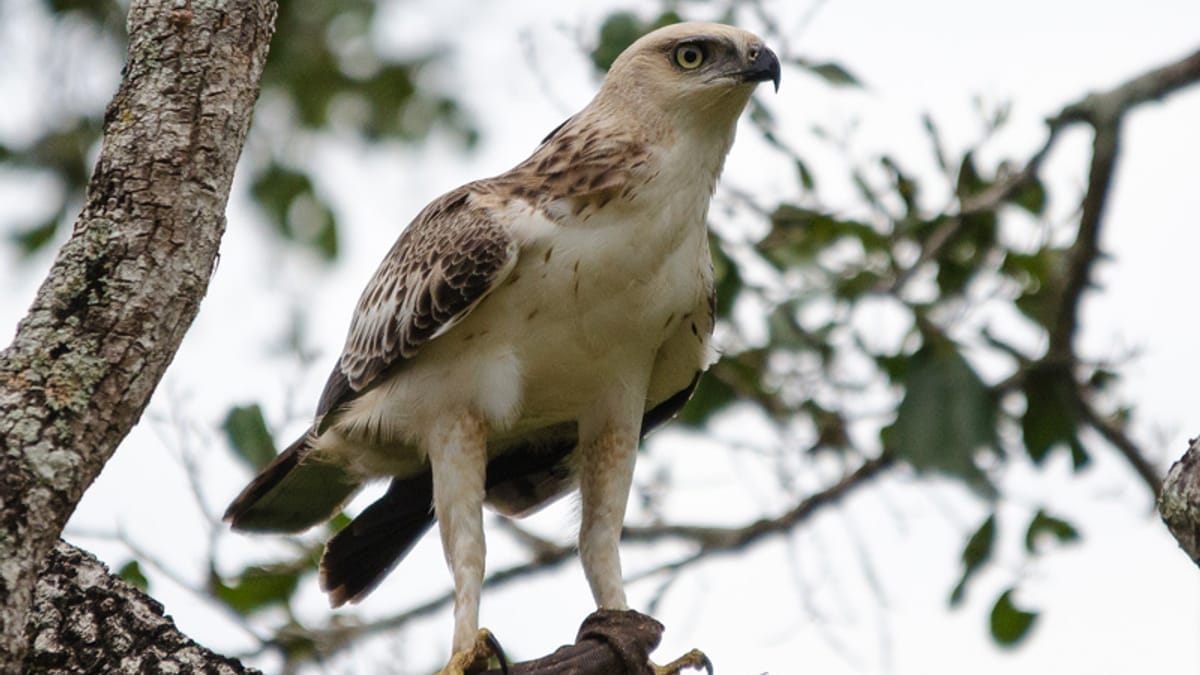
Image: Ulf Rydin · Wikimedia Commons (CC BY-SA 3.0)
The Changeable Hawk-Eagle in Yala
Most visitors come to Yala with their eyes at jeep height, scanning scrub for a tail tip or an ear twitch. Which is understandable. But the park's most consistent large predator spends most of its day about thirty metres above that sightline, and it is not a mammal.
The changeable hawk-eagle (Nisaetus cirrhatus) is Yala's resident big raptor, and it earns its name honestly. No two individuals look quite alike, and the same bird can look different at different ages. If you've photographed what you thought were three separate hawk-eagles on one trip, there's a real chance it was one bird, twice, plus a juvenile.
Why "changeable" is not just a cute name
Most raptors settle into a fairly fixed adult look. This one doesn't. Changeable hawk-eagles run a long gradient from pale, almost washed-out birds to dark, heavily barred ones, and the pattern shifts again through successive moults as a bird ages from juvenile to full adult.
That variability used to cause real taxonomic headaches. The species was originally bundled into the genus Spizaetus with the Americas' hawk-eagles, until genetic work showed that grouping was artificial, lumping together birds that weren't actually each other's closest relatives. The Old World hawk-eagles, this one included, were moved into their own genus, Nisaetus. If you see older field guides or signage still using Spizaetus cirrhatus, that's not wrong exactly, just out of date.
One feature stays constant across all that plumage variation and is the quickest way to confirm you're looking at a hawk-eagle rather than one of Yala's other mid-sized raptors: feathered legs. The tarsus is covered in feathers right down toward the foot, a trait shared by the subfamily Aquilinae (the "booted eagles") but absent in most of the tropical hawks and buzzards sharing the same airspace. Bare yellow legs, not this bird. Feathered trousers down to the toes, hawk-eagle.
What it's actually doing up there
This is not a soaring, wide-horizon eagle like the ones you picture scanning open plains. The changeable hawk-eagle is a forest hunter, built for agility rather than range, and it works the canopy edges and mixed scrub that make up most of Yala's Block I interior.
Its diet is opportunistic to a degree that's genuinely impressive for a raptor this size. Birds, small mammals, reptiles, even other vertebrates get taken depending on what's available and how easy it is to reach. This flexibility is a big part of why the species is, across its whole range from India through Sri Lanka into parts of Southeast Asia, the most widespread and adaptable member of its genus. Other Nisaetus hawk-eagles tend to be fussier about habitat and diet. This one isn't, which is exactly why it does well in a patchwork landscape like Yala, where dense monsoon forest, open parkland and scrubby transition zones all sit within a short flight of each other.
Watch one for long enough and you'll usually see it do one of two things: sit motionless on an exposed branch scanning the ground below, or stoop fast and low through gaps in the canopy after something it's already spotted. It is not an aerial acrobat in open sky the way a changeable kestrel or a pair of displaying brahminy kites can be. Most of the real hunting happens inside the tree line, which is also why it's harder to photograph well than Yala's open-country birds.
Where to actually find one
Hawk-eagles are territorial and tend to work the same patch of forest for extended periods, which is good news for anyone trying to find one on a fixed two or three-hour safari slot rather than relying on blind luck.
The denser tree cover around Block I, particularly near the transitional belts where forest meets open grassland, is a consistently productive zone. Trackers who spend their working lives in the park often know a resident bird's preferred perch trees the way regular visitors know a leopard's favourite rock. If you tell your tracker you're specifically after raptors rather than just "big cats," most will happily divert toward known hawk-eagle territory, since it costs nothing in terms of the main game drive.
Early morning, in the first couple of hours after the park gates open, is a strong window. The birds are often still on exposed perches warming up and digesting, before the day heats up and they drop into cover or ride thermals higher where they're harder to pick out. During the drier months, roughly from May through September when Yala's undergrowth thins out and visibility through the scrub improves generally (see When to Visit Yala for the fuller seasonal picture), spotting any mid-canopy raptor gets noticeably easier simply because there's less foliage to hide behind.
Telling it apart from Yala's other raptors
Confusion mostly happens with two other residents. The crested serpent eagle, also common in Yala, is bulkier-headed, has a more obvious black and white banded tail, and (true to its name) specialises more heavily in snakes, which changes its hunting posture, often perched lower and stiller over open ground or water margins. The changeable hawk-eagle, by contrast, carries a slimmer silhouette, a more prominent head crest on many individuals (though not all, thanks again to that plumage variability), and that diagnostic feathered leg.
Shikras and other smaller accipiters sometimes get mistaken for juvenile hawk-eagles at a distance, but size is the giveaway once you've got any sense of scale: a changeable hawk-eagle is a notably larger bird, closer in bulk to a small eagle than to a sparrowhawk.
None of this is DWC-verified data in the way a leopard census might be. Precise population figures for the species inside Yala specifically don't appear to be publicly published, and claims of exact numbers should be treated with suspicion if you see them elsewhere. What's well established is the broader pattern: this is a widespread, adaptable species across South and Southeast Asia, and Yala's mixed habitat suits it well, which is consistent with how often resident birds turn up on repeat visits to the same stretches of Block I.
Sources
- Wikipedia, "Changeable hawk-eagle", https://en.wikipedia.org/wiki/Changeable_hawk-eagle
- Department of Wildlife Conservation Sri Lanka
Ready to see it for yourself?
Book a safari