 YALA
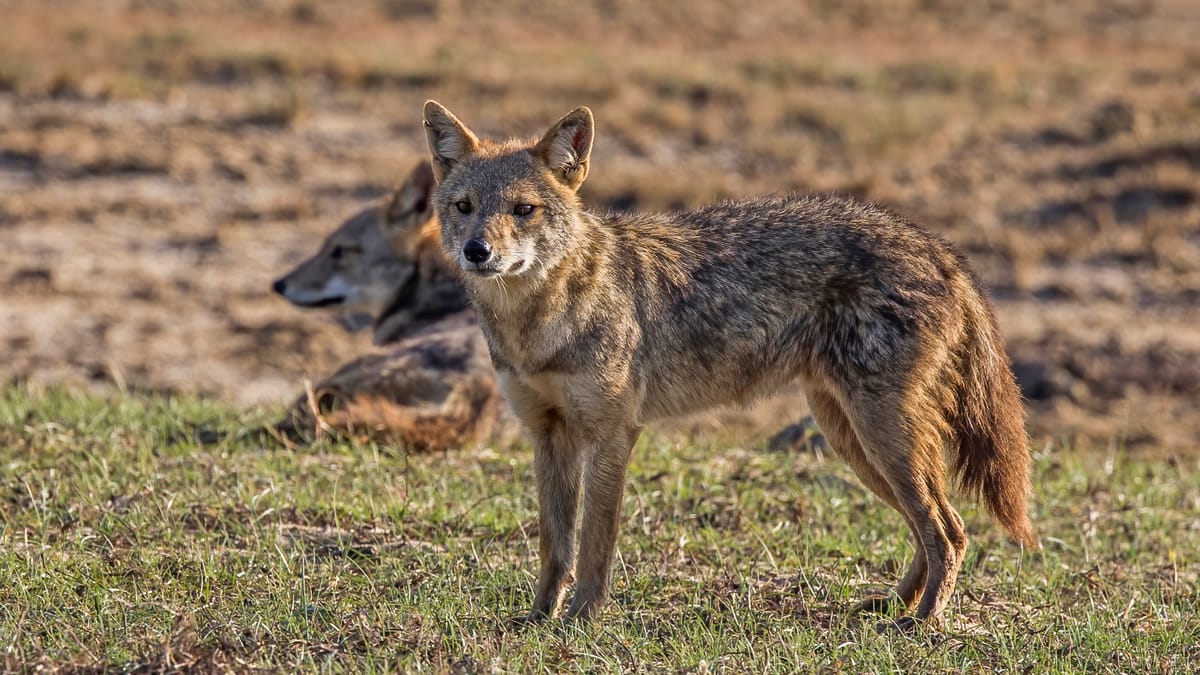
Image: Charles J. Sharp · Wikimedia Commons (CC BY-SA 4.0)
The Sri Lankan Jackal in Yala
Ask a first-time visitor to name Yala's predators and you'll get leopard, maybe sloth bear if they've done their homework. Nobody says jackal. Which is odd, because the jackal is probably the predator you'll see most often, and the one your driver will point at with the least ceremony.
Sri Lanka's jackal is a subspecies of the golden jackal, Canis aureus naevus, found only on the island. It's not a scaled-down wolf and it's not a scruffy stray dog, though at a glance in poor light it can look like either. It's its own animal, with its own routines, and Yala happens to be one of the better places in the world to actually watch it work.
What you're actually looking at
The golden jackal is a genuinely widespread species, found from southeastern Europe across the Middle East and into South Asia. Genetically it sits much closer to wolves and coyotes than to the African black-backed jackal or side-striped jackal, despite the shared name. Those African species belong to a different genus entirely. The "jackal" label is really a hangover from early naturalists grouping similar-looking, similar-sized canids together rather than a statement about ancestry.
Sri Lanka's population is smaller-bodied than the jackals of northern India or the Middle East, as is typical of tropical, resource-rich habitats where a compact frame is enough. Build is lean: long legs relative to a fox but shorter than a wolf's, a pointed muzzle, a low forehead, and a tail that's noticeably shorter and less bushy than a wolf's brush. Coat colour shifts with the animal's coat cycle rather than dramatically with season the way it does in colder parts of the range, since Yala doesn't get a winter coat change. Expect a tawny, sandy-grey animal with darker guard hairs along the back, paling toward the belly, which does a decent job of matching the parched grass and pale soil of the dry season.
Why Yala suits them
Jackals are built for exactly the kind of country Yala has plenty of: open scrub, grassland edges, tank margins and the thorny transition zones between forest blocks, rather than deep, closed-canopy jungle. That habitat preference is precisely why sightings cluster around Yala's water bodies. The bunds and shorelines of tanks like Buttuwa and the grasslands near the Block I entry roads give jackals both the open sightlines they like and a reliable buffet: fish stranded by falling water levels, insects kicked up by grazing deer, and the fruit that drops from palu and weera trees in season.
That's the other thing worth knowing: jackals are not strict carnivores. They're opportunists in the fullest sense, eating insects, fallen fruit, small reptiles, ground-nesting bird eggs, and carrion, on top of actively hunted prey like hares, rodents, and fawns of chital or barking deer when the chance arises. A jackal will happily follow a leopard's kill site at a distance, waiting for scraps, or trail a jeep track for whatever a picnic drops. This flexibility is a big part of why the species is listed as Least Concern by the IUCN. It doesn't need pristine wilderness. It needs edges, and edges are one thing Yala has no shortage of.
Family life on the tank bund
The basic jackal social unit in Yala is a mated pair, often with a litter of pups from earlier in the year still hanging around as helpers. This is worth watching for because it's genuinely unusual behaviour: young jackals sometimes delay dispersing and instead help raise the next litter, guarding pups and even regurgitating food for them. It's a rare example, among Sri Lanka's larger mammals, of cooperative breeding you can actually witness from a jeep if you're patient near a den.
Dens are usually old termite mounds, hollowed-out embankments, or abandoned burrows widened to suit, and they're reused across seasons if undisturbed. Pups typically appear in the months following the northeast monsoon's tail, broadly December through February in Yala's rhythm, when the receding water levels concentrate prey and make provisioning easier. This isn't a precisely documented breeding calendar for the island, so treat it as a general seasonal pattern rather than a fixed date. What is reliable is the give-away sound: pairs and family groups call to each other with a rising, yipping howl, often at dusk, and one call in Block I tends to set off an answering chorus from another group across the scrub. Guides use it the same way they use chital alarm calls, as a rough locator for what else might be moving.
Reading a jackal sighting
A jackal crossing the track alone in daylight, trotting with apparent purpose, is usually commuting between den and feeding ground rather than hunting. A pair moving with heads low and ears forward near a water's edge is more likely working for something, frogs, crabs, or a wounded bird. If you see three or four together loping in the same direction at pace, it's worth glancing at what's ahead of them: jackals will shadow a leopard's fresh kill or trail a jackal pack mate that's found carrion, and their body language changes noticeably from the aimless daytime trot to a focused, low-slung approach.
They're also, unlike leopards, not shy about being seen. Jackals in Yala have grown used to jeep traffic and will often hold a stare at the vehicle for a few seconds before carrying on, rather than bolting. That habituation, plus their preference for open ground, is exactly why sightings are so consistent. If your safari has produced no cats and no bear, a jackal trotting the tank bund at golden hour is a reasonable consolation, and honestly a more interesting animal to actually watch than most visitors give it credit for.
Sources
- Golden jackal, Wikipedia, https://en.wikipedia.org/wiki/Golden_jackal
- Department of Wildlife Conservation Sri Lanka
Ready to see it for yourself?
Book a safari