 YALA

The Asian Water Buffalo in Yala's Tanks: Wild, Feral, or Something In Between
You've probably heard that the buffalo lying chest-deep in a Yala tank is a "wild water buffalo", the ancestor species of the domestic animal, same as the leopard or the elephant, a true wild resident of the park. We checked. The honest answer is: probably, partly, and nobody will tell you with total confidence which.
That's not a knock on Yala. It's a genuinely unresolved question across most of the animal's range, and it's a more interesting story than the brochure version.
What the Species Actually Is
The wild water buffalo, Bubalus arnee, was formally described in 1792 and is generally accepted as the ancestor of the domestic water buffalo found on farms from Egypt to the Philippines. It's native to the Indian subcontinent and parts of Southeast Asia, a huge, heavy-set bovine built around wide, backward-curving horns that can be genuinely massive, among the largest of any living bovid.
Globally it is listed as Endangered by the IUCN, a status it has held since 1986. The current estimate puts the wild population at fewer than 4,000 mature individuals, concentrated in scattered pockets of India (notably Assam), Nepal, Bhutan, Thailand and Cambodia. That is a small number for an animal this size and this visible. Compare it to the roughly 6,000 or so Sri Lankan leopards estimated island-wide, and you start to see why wildlife biologists treat genuinely wild buffalo populations with more concern than most visitors assume.
The complication is the word "genuinely". Water buffalo have been domesticated for thousands of years across South and Southeast Asia, and domestic animals have escaped, been released, or simply interbred with wild herds in almost every range country. Pure wild populations, unmixed with domestic bloodlines, are now rare even in places with large buffalo numbers.
Where Sri Lanka Fits, and Where It Gets Murky
Sri Lanka has a large buffalo population, and Yala's tanks are full of them. What's debated is how much of that population descends cleanly from the original wild stock versus from centuries of mixing with domestic and feral herds kept by villages that once bordered, or sat inside, what is now parkland.
Many of the buffalo you'll see in Block I, wallowing at Buttuwa Tank or grazing the margins of Maha Seelawa, are physically large, dark, heavily horned animals that look every bit the wild type. Whether they're genetically "pure" wild water buffalo in the strict sense used by conservation geneticists is a question that, to our knowledge, hasn't been settled with the kind of rigorous sampling done for populations in Assam's Kaziranga, which is often cited as holding the most secure wild population left. We'd rather say that plainly than repeat the confident claim that Yala's herds are textbook wild buffalo. It's an honest grey area, and that grey area is itself worth knowing before you point your camera.
What isn't in doubt is the ecological role. Whatever their exact lineage, Yala's buffalo behave like wild animals, wary of vehicles, quick to retreat into reed beds, entirely unmanaged by anyone. They are not anyone's livestock. For a visitor's purposes, that's the distinction that matters.
Built for the Mud
Everything about a water buffalo's body is an argument for wallowing. The dark skin is thin and sparsely haired, which means poor insulation against the tropical sun, so the animal solves the problem by coating itself in tank mud instead of growing a coat. The mud also deters flies and ticks, which in Yala's dry season heat are relentless on any exposed animal.
Their feet are wide and splayed, closer to a design for walking on soft lake-bed silt than the compact hooves of deer or sambar built for firmer ground. That's why you rarely see buffalo far from standing water for long. Unlike elephants, which will range for kilometres between waterholes, buffalo keep a short tether to the tanks, usually visible from the jeep track with nothing more than a pair of binoculars.
The horns deserve a mention on their own. On a mature bull they sweep back in a wide crescent, sometimes close to two metres across tip to tip in the largest recorded animals elsewhere in the species' range, though Sri Lankan individuals tend to run smaller. They're used in dominance clashes between bulls, usually a slow, deliberate pushing contest rather than the fast charges associated with gaur or wild cattle elsewhere in Asia.
Tanks as a Seasonal Lifeline
Yala's ancient irrigation tanks, Buttuwa, Uraniya, Maha Seelawa and the smaller pans scattered through Block I, were originally built centuries ago for paddy cultivation, long before the area became a protected park. Today they do double duty as the dry season's central wildlife infrastructure, and buffalo are usually the most visible beneficiaries.
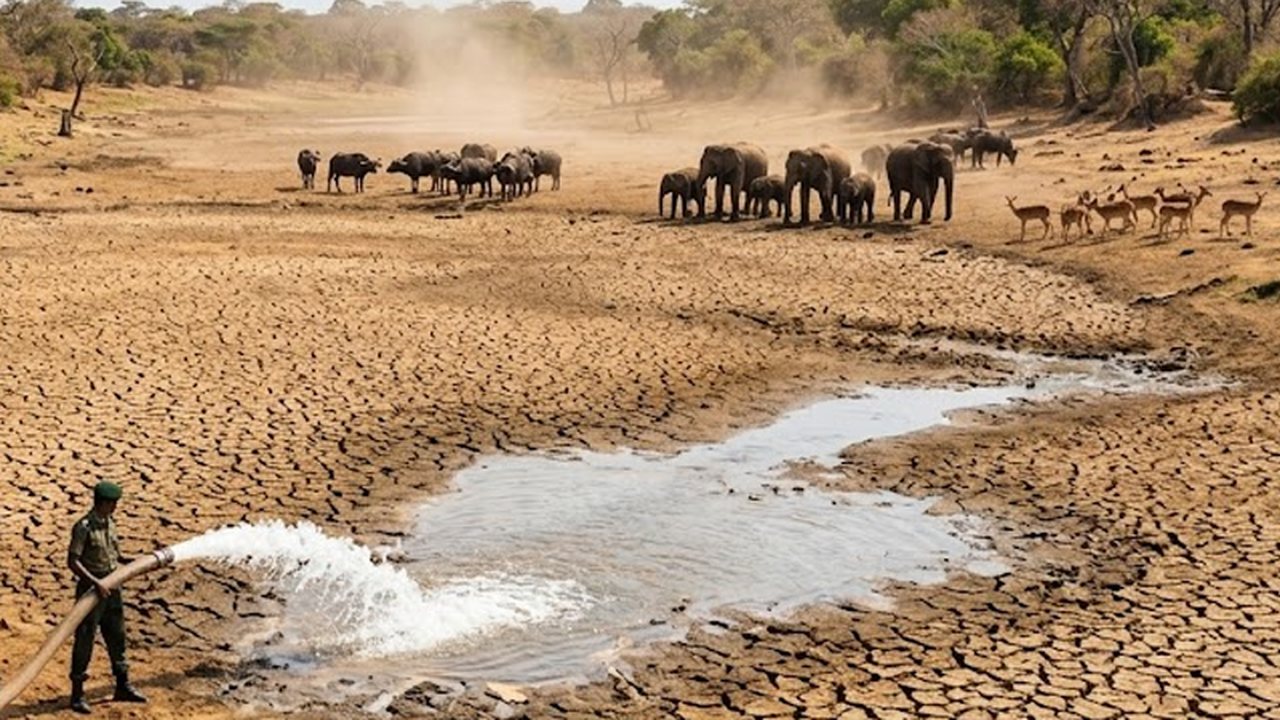
From around May through September, as the southeast monsoon pattern leaves Yala dry and surface water shrinks fast, buffalo concentrate hard around whatever tanks still hold water. Herds that might be loosely scattered in the wetter months pack into visible groups of a dozen or more, often sharing the same waterhole with spotted deer, wild boar and, at a wary distance, elephants. It's one of the more reliable dry season sightings in the park, and it ties directly into why DWC has in past dry seasons had to bring in water bowsers for the hardest-hit tanks, a stopgap measure covered in more detail in our piece on the dry season water bowsers.
By contrast, in the wetter months around November to January, buffalo disperse further into the grasslands and scrub, and sightings become more opportunistic. If a reliable buffalo photograph at close range on a tank bund is what you want, the dry season window is the one to plan around, something we cover more broadly in When to Visit Yala.
Herd Life and a Word of Caution
Buffalo herds are matriarchal, typically a core of related females and calves with adult bulls moving between groups or holding loosely to the periphery. Calves are usually born in the latter part of the year, timed so that the most vulnerable weeks of a calf's life don't coincide with the hardest dry months.
They are also, species-wide, considered one of the more genuinely dangerous large herbivores to approach on foot, a reputation built mostly on African buffalo but broadly true of the Asian species too. In Yala that's rarely an issue because nobody should be approaching any large mammal on foot in the first place. From a jeep, buffalo tend to be placid, more interested in the mud than in your vehicle, and among the easiest big animals in the park to watch at length without disturbing them.
Sources
- Wikipedia, "Wild water buffalo", https://en.wikipedia.org/wiki/Wild_water_buffalo
- Department of Wildlife Conservation Sri Lanka
Ready to see it for yourself?
Book a safari