 YALA
Image: Lesandu6 · Wikimedia Commons (CC BY-SA 4.0)
The Crested Serpent Eagle in Yala
Everyone in the jeep is scanning the scrub for stripes. Meanwhile there is a bird sitting on a dead branch above the track, in plain sight, that most visitors never properly look at. That is the crested serpent eagle's whole deal. It is probably the most frequently seen raptor in Yala, and probably the most ignored.
What you are actually looking at
Spilornis cheela is a medium-sized bird of prey, built heavier and more compact than the hawk-eagles it shares the park with. The head looks oversized for the body, an effect created by long feathers at the back of the skull that fan out into a loose mane and crest when the bird is alert or displaying. The face is bare skin, bright yellow, running straight into the yellow cere above the bill, so from the front the whole face reads as one unbroken patch of colour. Drop your eyes to the feet and you will see another identifying feature: thick, unfeathered, heavily scaled legs, built for gripping something that moves and resists.
In flight, which is where most visitors actually clock it, the giveaway is the tail and wings. Broad, rounded wings carried in a shallow soar over the canopy, and a tail barred in wide black and white bands that show clearly even at a distance, especially when the bird banks. It is not a fast, stooping hunter in the way a falcon is. It is a patient, soaring forager that works the thermals above the forest block, watching the ground.
Taxonomically the crested serpent eagle is something of a moving target. Across its enormous range, from the Indian subcontinent through Southeast Asia into East Asia, the species splits into a long list of subspecies, and ornithologists do not fully agree on where the species line should sit. Several populations once lumped in with S. cheela, including the Philippine serpent eagle, the Andaman serpent eagle and the South Nicobar serpent eagle, have since been promoted to full species status by most authorities. Sri Lanka's resident birds belong to the subcontinental population, and are a fixed, non-migratory presence in Yala's forest and scrub blocks year round.
The name is not poetic licence
Snakes really are the preferred prey, and the bird is built for the job. Those heavily scaled legs are thought to offer some protection against a bite, in the same way a secretary bird's legs do, though nobody is suggesting the eagle is immune to venom. It will also take lizards, frogs, rodents and large insects when the opportunity presents itself, and it is not above raiding a smaller bird's nest. But the specialism in reptiles is real, and it puts this eagle in the same subfamily, Circaetinae, as the snake-eagles of Africa and the Mediterranean (the Circaetus group), a lineage that converged independently on the same hunting niche.
Watch one hunting and the method becomes obvious. It perches, often quite low, on a bare branch at the edge of a clearing or along a tank bund, and waits. Serpent eagles are not built for long tail-chases. They drop onto prey from a perch or a low glide, pin it with those scaled feet, and finish it on the ground rather than in the air. If you see one standing on the track itself, wings slightly spread, that is often a bird that has just made a kill and is mantling over it, shielding the catch from opportunistic crows and other eagles.
The call that gives it away before the bird does
Long before you see the eagle, you will probably hear it. The crested serpent eagle has one of the most recognisable calls in Yala's soundscape: a loud, piercing, two or three note whistle, often rendered by birders as something close to "kluee-kluee-klueee", repeated insistently from a high perch or delivered in flight. It carries a long way over the canopy and is used year round, not just in breeding season, which makes it a reliable ambient marker of the forest rather than a seasonal event.
Trackers in Yala use it as working information. A serpent eagle calling and circling tightly over one patch of forest, rather than soaring on, sometimes indicates disturbance below, a troop of langurs mobbing something, or a predator moving through. It is not as precise a leopard indicator as a chital alarm call (worth reading Chital Alarm Calls and Leopard Tracking in Yala for that system properly), but an experienced tracker will clock an agitated serpent eagle the same way they clock agitated deer: as one more layer of information about what else is moving in the block.
Where to actually find one in Yala
This is a canopy and forest-edge bird rather than an open-grassland one, so the best places to look are the denser, taller tree cover rather than the classic open plains. The forest fringes around Block I, particularly near watercourses and tank edges where tall dead trees give a clear vantage over water, are consistently productive. Early morning, in the first hour or two after the park gates open, is a good window, since the bird favours low soaring and perched hunting before the late-morning thermals pick up and it rises higher to circle, when it becomes a distant silhouette rather than a photographable subject.
There is no strong seasonal migration to plan around, since Sri Lanka's population is resident, but the dry season months from roughly May through September tend to concentrate all raptors, serpent eagles included, around the shrinking tanks and waterholes where prey is easier to find. That is also peak crowding season in the park itself, so for a quieter, more deliberate look at the bird, the shoulder months around April or October, discussed in more detail in When to Visit Yala, are worth considering.
Easy to confuse, worth telling apart
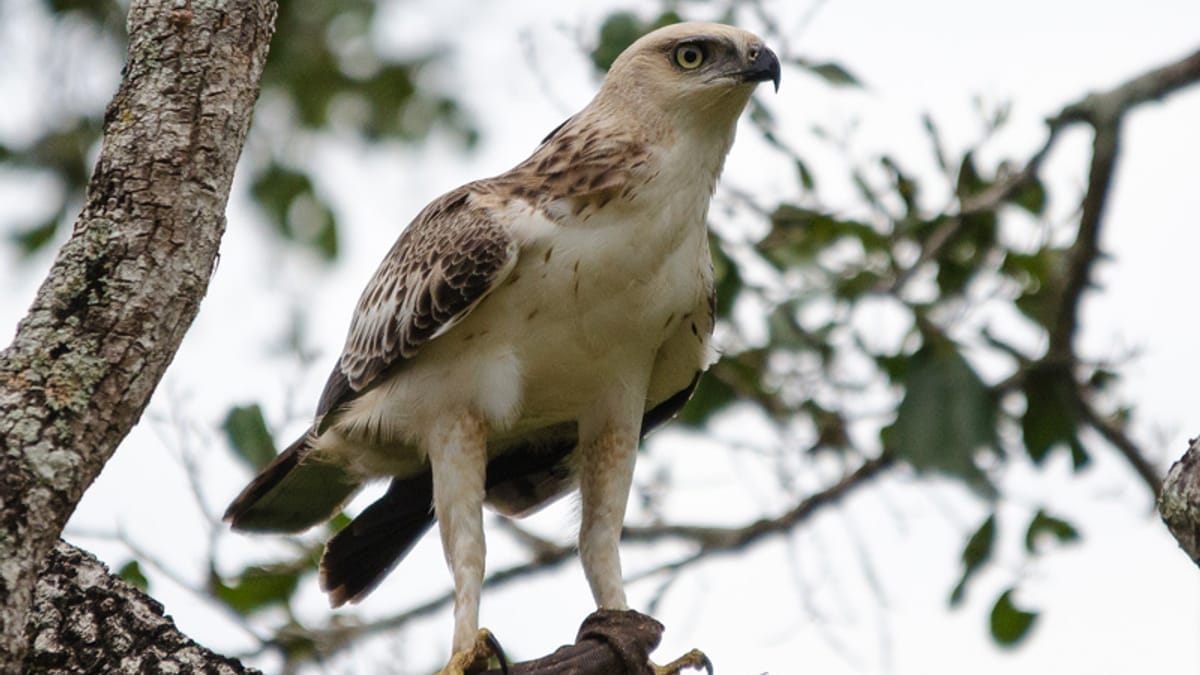
Visitors often lump every large raptor in Yala together as "an eagle" and move on. The crested serpent eagle is most often confused with the changeable hawk-eagle, which shares the canopy and the soaring habit. The quickest field separator is the tail banding (bold and even in the serpent eagle, narrower and less contrasting in the hawk-eagle) and that unmistakable bare yellow face, which the hawk-eagle does not share. For a direct side-by-side, see The Changeable Hawk-Eagle in Yala.
It is not a rare bird, and it will never generate the jeep traffic a leopard sighting does. But it is one of the most honest indicators of Yala's forest health, since it depends on an intact canopy, a healthy reptile population and undisturbed perches to hunt from. A park with serpent eagles calling through the morning is a park still functioning the way it should.
Sources
- Wikipedia, "Crested serpent eagle", https://en.wikipedia.org/wiki/Crested_serpent_eagle
- Department of Wildlife Conservation Sri Lanka
Ready to see it for yourself?
Book a safari