 YALA
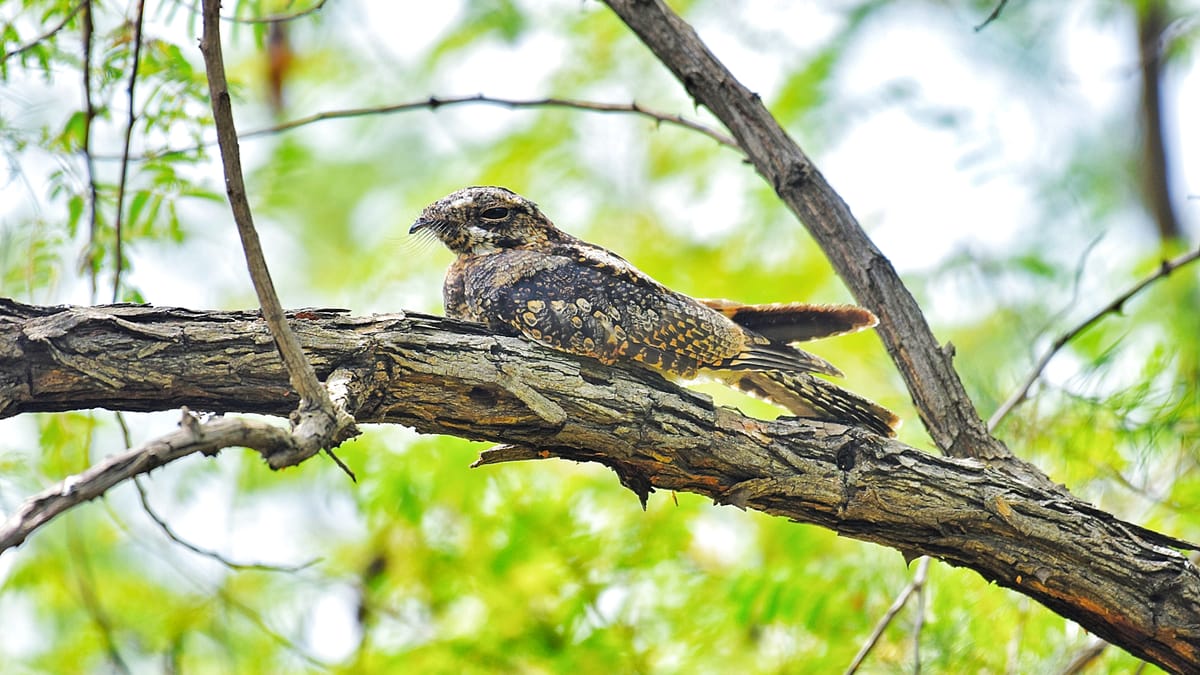
Image: Shiv's fotografia · Wikimedia Commons (CC BY-SA 4.0)
The Indian Nightjar's Camouflage Trick and Why It Roosts on Yala's Roads
You've probably heard that Yala's leopards are hard to spot because of their camouflage. We checked, and that's true enough, but there's a bird in the same park doing something far more extreme with far less fanfare.
The Indian nightjar (Caprimulgus asiaticus) is roughly the size of a myna, patterned in greys and browns that match dry leaf litter so precisely that guides sometimes drive within a few feet of one without seeing it. Unless it moves, you won't find it. Most visitors never do, not because the bird is rare, but because it's doing its job too well.
A bird built to disappear
Nightjars don't hide in dense cover the way you'd expect a camouflaged animal to. They sit in the open, on bare ground, gravel tracks, or sun-baked soil, relying entirely on pattern-matching rather than concealment behind something. The plumage is mottled in a way that breaks up its outline against stone and dirt rather than leaves, which is exactly the terrain Yala's dry zone offers for most of the year.
This is a resident breeder across South Asia and into Southeast Asia, and across that range the plumage varies enough that even experienced birders find it genuinely difficult to separate from other nightjar species in the field. In Sri Lanka it shares scrub and open country with relatives, and distinguishing them by sight alone, especially at dusk, is not something we'd claim to do reliably either. Calls are the more honest way in.
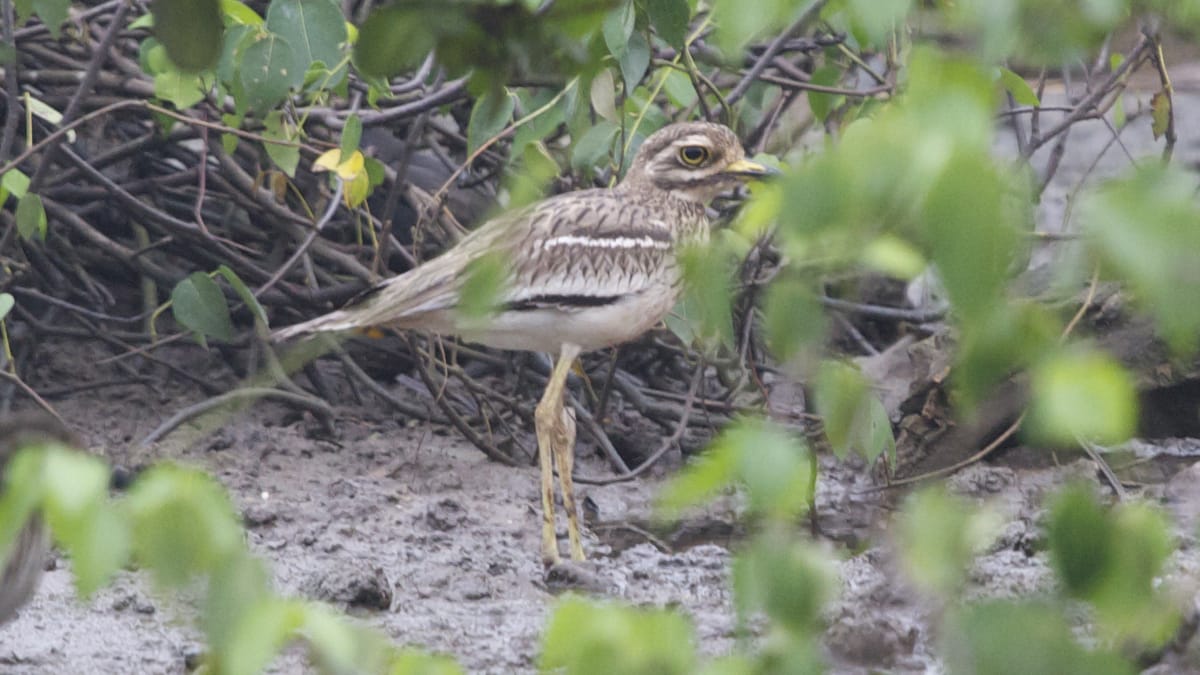
If you want the full lineup of nightjars and their daytime look-alike, the Eurasian thick-knee, that shares this same dry scrub habitat, we've covered the comparison in The Eurasian Thick-knee and Nightjars of Yala's Dry Scrub.
The sound that gives it away
By day the Indian nightjar is close to unfindable. At dawn and dusk it isn't, because it calls, and the call is distinctive enough that once you've heard it you won't mistake it again. It's often described as a series of clicks that quicken and shorten, something like a stone skimming across ice and slowing into a stutter. In the stillness of Yala just after the gates close for the evening, or in the half-light before the morning safari queue forms at the entrance, that sound carries a long way across open scrub.
Nightjars are crepuscular, active at twilight and through the night rather than in full daylight, which is why the birders who do track them deliberately time their visit around those two windows rather than the main safari hours. If you're only doing the standard 6am to 10am and 2.30pm to 6pm game drives, you'll catch the tail end of the dusk activity at best.
Why the road matters
This is the detail that surprises people. Nightjars in Yala are most commonly seen not in trees or grass but sitting directly on the track, particularly the gravel and packed-earth jeep roads inside Block I. The reason is simple once you think about it: those roads hold the day's heat into the evening, and a nightjar settling onto still-warm ground after dusk gets a small thermal advantage while it waits for insects stirred up by passing vehicles.
The giveaway isn't the bird's shape. It's the eyeshine. A nightjar's eyes catch a spotlight or headlamp beam and throw back a flat red glow, two small coals sitting at ground level in the middle of the track. Drivers moving slowly after dusk, heading back toward the Palatupana entrance or shifting between tracks near Buttuwa, sometimes catch that glint before the bird itself resolves into focus. It's one of the more reliable ways to actually confirm a sighting, because trying to pick out the mottled body against gravel by eye alone, without the eyeshine, is close to hopeless.
This habit also means nightjars are one of the few birds in the park genuinely at risk from vehicles rather than from the other way around. A bird sitting still on a warm road, trusting its camouflage against a stationary predator, has no evolved response to a jeep's headlights. Slow, deliberate driving after dusk inside the park isn't just about leopard sightings. It's partly about not driving over something you didn't see.
Season and timing
Being a resident breeder rather than a migrant, the Indian nightjar doesn't disappear from Yala for part of the year the way some of the park's migratory waders and raptors do. It's present year round. What changes seasonally is detectability, not presence.
The dry months, roughly from May through September, leave Yala's scrub thin and its tracks bare, which makes roadside sightings somewhat easier simply because there's less vegetation competing for the bird's attention and less cover elsewhere to roost in instead. We'd flag this as a reasonable inference rather than a confirmed pattern, since we're not aware of published seasonal count data for this species inside the park specifically. If you're planning a visit primarily around bird activity more broadly, our season guide covers the wider picture of what's active when.
Breeding behaviour in nightjars generally involves no real nest, just a scrape on open ground, eggs laid directly onto bare earth or leaf litter, and camouflage doing the protective work that a built nest would do for other species. We haven't seen confirmed, dated records of nightjar breeding activity specific to Yala, so take this as background on the species rather than a claim about local timing.
What to actually do about it
Realistically, don't go into Yala hunting for an Indian nightjar as a primary goal. Treat it as a bonus for anyone on an early evening exit drive or anyone camped inside the park, where dusk and dawn sounds are part of the experience rather than something you're racing past in a jeep. Listen for the clicking call near open ground close to camp. On the drive out, watch the track itself rather than the bush on either side, and look for the red eyeshine low down rather than a bird-shaped silhouette.
It's a small, unglamorous way to notice a park that most people experience only through its big mammals. The nightjar doesn't perform for cameras and won't show up on anyone's highlight reel. It just sits there, invisible until it isn't, which might be the more honest Yala story anyway.
Sources
- Wikipedia, "Indian nightjar", https://en.wikipedia.org/wiki/Indian_nightjar
Ready to see it for yourself?
Book a safari