 YALA
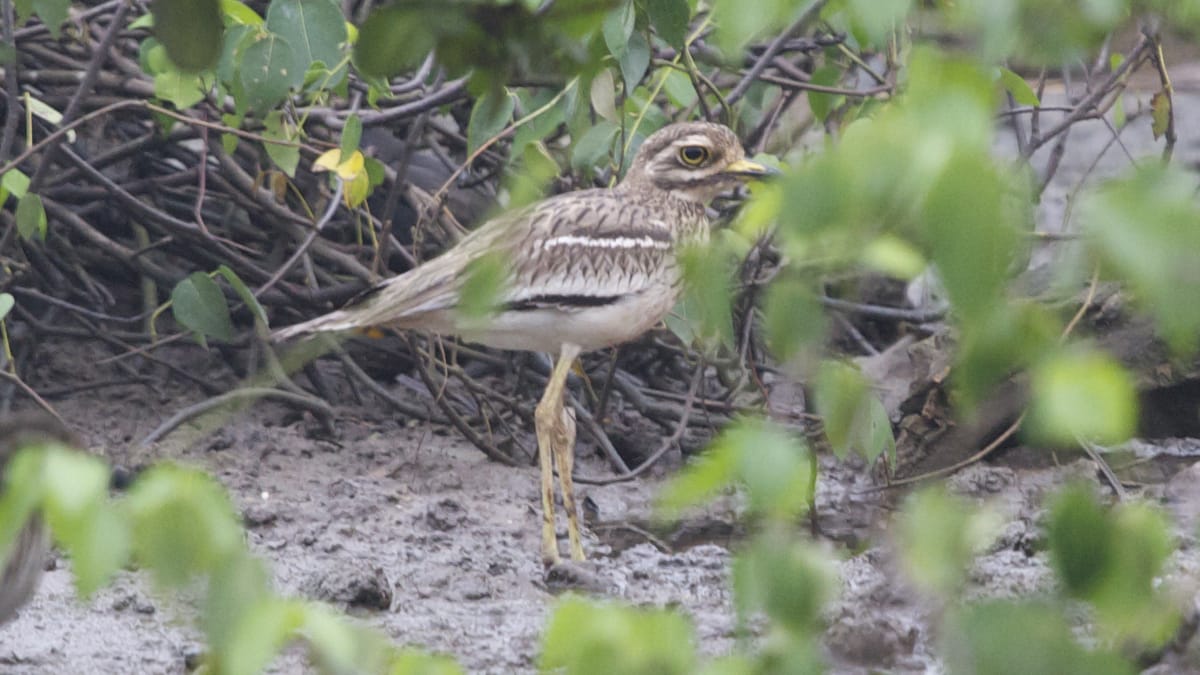
Image: Lip Kee from Singapore, Republic of Singapore · Wikimedia Commons (CC BY-SA 2.0)
The Eurasian Thick-knee and Nightjars of Yala's Dry Scrub
Most people drive straight past these birds. Not because they're rare. Because they're lying on the ground doing an extremely good impression of a stone.
That's the whole trick of the thick-knee and the nightjar alike. Yala's dry scrub, with its litter of sun-bleached gravel, dead leaves and pale sand, has produced two unrelated groups of birds that arrived at the same solution: freeze, blend in, and let the jeep roll past.
The Bird Everyone Calls a Curlew but Isn't
What tourism leaflets often label the "Eurasian thick-knee" in Sri Lanka is, strictly, a different bird. The species found here is the Indian stone-curlew, Burhinus indicus, which was only split from the Eurasian stone-curlew as its own species relatively recently in taxonomic terms. For decades it was treated as a subspecies of the Eurasian bird. If an older field guide on your shelf still calls it that, it isn't wrong exactly, just out of date.
The confusion is understandable. The two birds look similar, behave similarly, and both get called "thick-knee" for the same reason: thick, knobbly leg joints that look oddly over-engineered for a bird this size. But the Indian stone-curlew is its own species, found across the plains of South and Southeast Asia, and it's the one you'll actually find in Yala's scrub blocks, not its European cousin.
Either way, the bird you want to look for has a streaky brown back, a pale belly, and eyes that are disproportionately large even by bird standards. Those eyes aren't decorative. This is a bird built for working at dusk and after dark, and in low light, big eyes gather what little there is.
Camouflage as a Survival Strategy, Not a Metaphor
Spend one evening drive in Block I and you'll understand why thick-knees so rarely get photographed on purpose. Streaked brown plumage against dry-season soil, especially around the cracked clay flats near tank beds, is genuinely difficult to pick out even when a tracker points directly at it. The bird knows this. Its first response to a jeep isn't to fly. It's to crouch, stretch its neck low, and trust the camouflage.
This is a deliberate strategy, not laziness. Flying draws the eye of predators (and, historically, of hunters). Staying still and relying on disruptive patterning is cheaper, energetically, and usually works. It's the same logic Yala's nightjars use, which is why the two groups end up discussed together despite not being closely related.
Thick-knees are mostly nocturnal or crepuscular, most active around dawn and dusk and through the night, which is also why visitors rarely see them doing anything except standing motionless during a daytime safari. Their calls, a series of wailing, curlew-like notes, are the reason for the "curlew" half of the name, and are far more often heard after dark from a campsite near when to visit Yala's drier months than seen on a jeep track.
Nightjars: The Scrub's Other Ground-Dwellers
Sri Lanka's dry zone, Yala included, holds a handful of nightjar species, among them the Indian nightjar and Jerdon's nightjar, both of which favour exactly the kind of open, stony scrub that dominates Block I and the drier stretches of Block II. I'll flag honestly that telling the two apart reliably in the field, especially at speed from a moving jeep, is genuinely difficult even for experienced birders, and call differences matter more than plumage in separating them.
What they share with the thick-knee is a total commitment to ground life. Nightjars don't build nests. They lay eggs directly onto bare earth or leaf litter, relying entirely on the eggs' mottled camouflage to survive the day undetected by jackals, monitor lizards and raptors. A sitting adult nightjar on a nest is, if anything, even harder to spot than a thick-knee, because it will often let a vehicle pass within a few metres rather than break cover.
Their calls carry much further than their bodies are ever visible. A churring, almost mechanical trill at dusk, overlapping with the thick-knee's wail and the alarm bark of a Sri Lankan jackal, is as much a part of a Yala evening as the engine noise of the jeep convoy heading for the exit gate.
When and Where You Actually Have a Chance
Yala does not run night safaris. Gates operate on fixed hours set by the Department of Wildlife Conservation, with vehicles required to be back out by dusk, so the bulk of both species' active window happens after visitors have legally left the park. That single rule shapes almost everything about how tourists experience these birds.
In practice, your best odds come in the final thirty to forty minutes before the evening safari ends, when light is dropping but the gate hasn't closed, and thick-knees and nightjars are just beginning to stir from their daytime stillness. Open, stony ground near tank beds and the drier interior tracks of Block I, away from the denser riverine patches favoured by deer and elephant, tends to produce more sightings than the lush edges most jeeps gravitate toward for mammal photography.
Dry season, roughly February through July depending on the year's rainfall pattern, thins out the ground vegetation and makes both species slightly easier to pick out against bare soil, though it also means less obvious contrast once the grass genuinely dies back and everything turns the same shade of dust. If you're staying overnight near the park boundary, which several camps and lodges around Palatupana permit, a still evening will often deliver far more thick-knee and nightjar calling activity than anything you'll record on the official drive itself.
A decent torch and a willingness to stand quietly outside your tent for ten minutes does more for these two groups than any amount of jeep time. Eyeshine from a nightjar's eyes, caught low and briefly in a beam, is often the only visual confirmation you'll get, a flash of orange-red a few inches off the ground, gone the moment the bird decides you've noticed.
Sources
- Indian stone-curlew, Wikipedia, https://en.wikipedia.org/wiki/Indian_stone-curlew
- Department of Wildlife Conservation Sri Lanka
Ready to see it for yourself?
Book a safari