 YALA
Why Yala's Crocodiles Lie There With Their Mouths Open: Basking at the Tissa Tank Boundary
Tissa Tank sits just outside Yala's formal boundary, a working reservoir that irrigates the paddy around Tissamaharama and doubles, unofficially, as one of the best places in southern Sri Lanka to watch a mugger crocodile do absolutely nothing. Visitors who pass it on the way to the park entrance often assume the crocodiles lying motionless on the bund are resting, or sunning themselves the way a tourist might. They're not relaxing. They're running a physiological operation with tighter tolerances than most of the mammals in the park.
This piece isn't about where to find Yala's crocodiles or how big they get, that ground is covered in The Mugger Crocodile of Yala's Tanks. This is about what's actually happening inside a basking crocodile, and why Tissa Tank's exposed, sun-baked margins make it such a good classroom for watching it.
Cold Blooded Is Not the Same as Lazy
A mugger crocodile cannot generate its own body heat the way a leopard or an elephant can. It's an ectotherm, which means its internal temperature tracks the environment unless it actively moves between warmer and cooler spots to hold itself in a workable range. That range matters enormously. Digestion, muscle power for an ambush strike, even the pace of its heartbeat, all of it depends on getting body temperature into roughly the low-to-mid 30s Celsius.
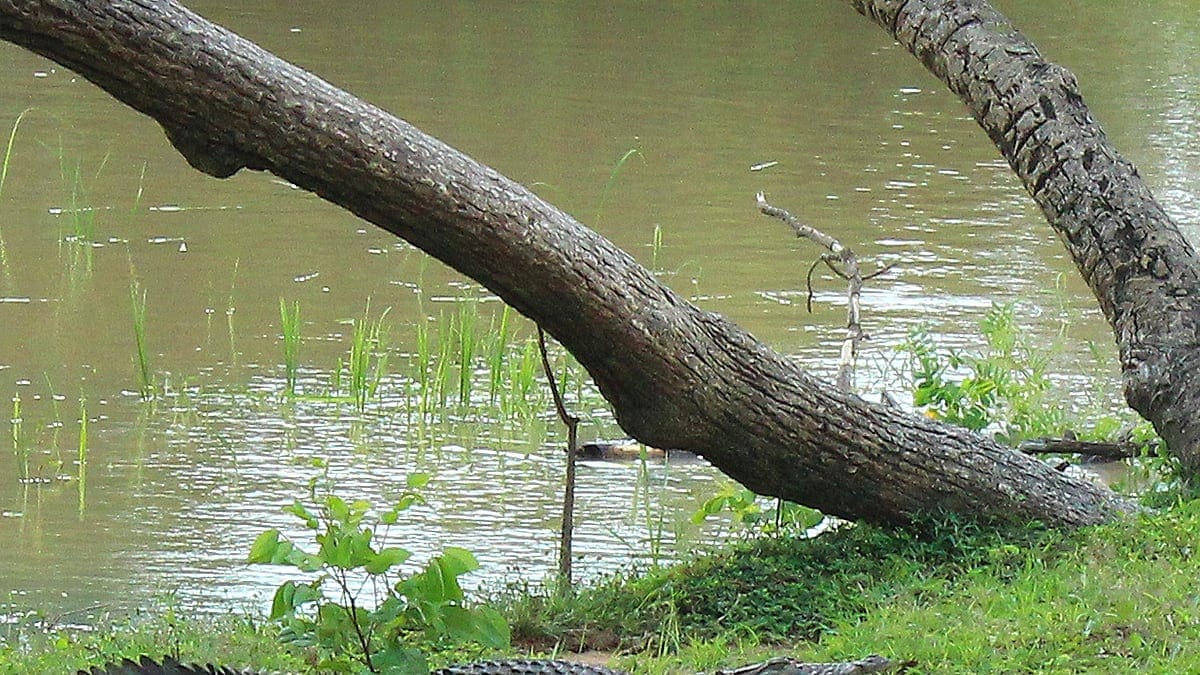
So basking isn't idleness. It's the crocodile equivalent of plugging in a phone. The animal hauls out onto bare mud or rock, orients its body broadside to the sun to maximise surface exposure, and lets dark, heat-absorbing skin do the work. At Tissa Tank, the exposed bund and the cracked mud flats that appear as water levels drop through the dry months give muggers exactly the kind of open, shadeless real estate this requires. It's no accident that basking numbers along that boundary visibly increase from around July through September, when the reservoir draws down and more bare ground is exposed to full sun.
The Burrow Math: 5°C and 38°C
Mugger crocodiles, uniquely among Sri Lanka's reptiles, dig their own burrows into the banks of tanks and rivers, and they use them as a kind of climate shelter rather than just a nesting feature. The known thresholds are specific. When ambient temperature drops below roughly 5°C, or climbs above roughly 38°C, the crocodile retreats underground rather than tolerating it on the surface.
Sri Lanka's lowland dry zone rarely sees anything close to 5°C, so the cold-end trigger is mostly academic here. The heat-end trigger is the one that matters at Tissa Tank. Midday temperatures in the dry season regularly push past 35°C in the open, and the mud surrounding the tank, unshaded and pale, can run hotter still. On the worst of those afternoons, the crocodiles that were lined up on the bund at eight in the morning are simply gone by noon, tucked into burrow mouths at the waterline or submerged with only eyes and nostrils showing. This is why a crocodile count done at midday on a hot dry-season day will almost always undercount the population, and why serious wildlife counts are done at dawn.
Reading a Basking Crocodile
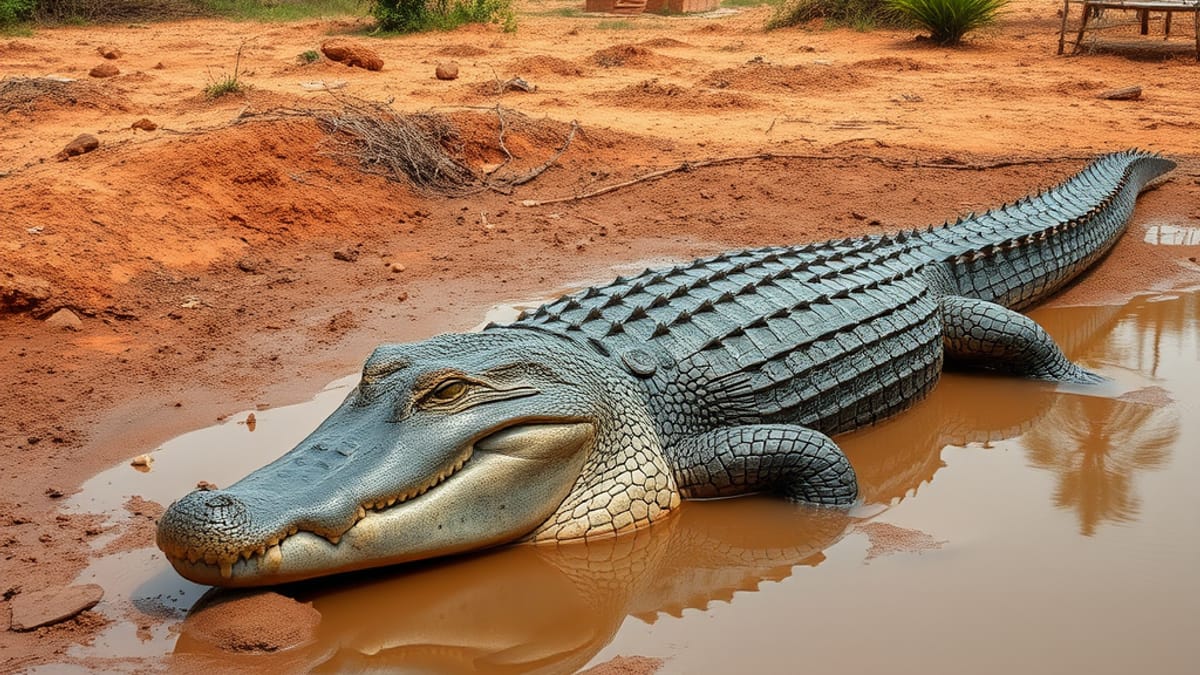
Watch one for more than a few minutes and the behaviour has a structure to it. Early morning, muggers bask with their bodies flattened and limbs splayed out from the torso, increasing contact area with warm ground. As body temperature climbs through the morning, many will open their mouths and hold them agape for long stretches, sometimes close to vertical.
That open-mouth gape looks aggressive to a first-time visitor. It isn't. Gaping is a well-documented cooling mechanism across crocodilians generally: evaporative heat loss from the moist lining of the mouth, combined with simply reducing the surface area angled directly at the sun. It's the reptilian equivalent of a dog panting, minus the panting. I'd flag that the fine detail of how much this contributes to a mugger's temperature regulation specifically hasn't been measured at Tissa Tank, as far as I know, so treat it as a sound general-biology inference rather than a site-specific study.
Once a crocodile's temperature target is reached, basking posture changes again. The animal angles itself at less direct exposure to the sun, or retreats partway into water, leaving only the dorsal armour exposed. A half-submerged crocodile with its back plates breaking the surface and the rest of the body cooling in the tank is often a thermoregulating animal fine-tuning rather than a hunting one.
Seasonal and Daily Rhythm
The pattern at Tissa Tank shifts with the year. During the main dry season, roughly May through September, water levels fall and basking sites multiply, but the heat pressure also intensifies, so baking happens in two short windows, early morning and late afternoon, with a long midday gap where the bund looks almost empty. During the wetter months, when the northeast and southwest monsoon influences overlap and bring intermittent rain to the south, cloud cover reduces solar intensity and basking sessions stretch longer through the day, since the risk of overheating is lower.
This daily rhythm is worth knowing if you're combining a Tissa Tank stop with a Yala safari. A drive past the tank at seven in the morning, on the way to an early entry at the park gates, will usually show more crocodiles hauled out than the same stretch of road at one in the afternoon. For broader timing advice across the whole park, When to Visit Yala covers the bigger seasonal picture.
Why the Boundary Location Matters
Tissa Tank isn't inside Yala's protected zones, which means the crocodiles using it live with a different set of pressures than the ones deeper in the park's tanks. They share the water with fishing activity, livestock, and foot traffic along the bund, and they're more exposed to the human-wildlife conflict situations that affect mugger populations across Sri Lanka generally, from entanglement in nets to incidents at the water's edge. The species is listed as Vulnerable by the IUCN, a status it has held since 1982, and protected by law in Sri Lanka, India and Iran, but protection on paper and protection on a working irrigation tank are two different things. Watching the basking behaviour here is also, in a quieter way, watching an animal managing its physiology in a landscape that was never designed with it in mind.
Sources
- Wikipedia: "Mugger crocodile", https://en.wikipedia.org/wiki/Mugger_crocodile
- Department of Wildlife Conservation Sri Lanka
Ready to see it for yourself?
Book a safari