 YALA
The Indian Palm Civet in Yala
You've probably heard it called a palm cat. Some guides still say "civet cat" over the radio when one crosses the track at Palatupana at dusk. We checked. It is not a cat at all. It is a viverrid, a family that split off from the cat and dog lineage tens of millions of years ago, and in Sri Lanka the species doing the crossing is almost always the Asian palm civet, Paradoxurus hermaphroditus, which locals and old colonial writers alike called the toddy cat.
That name is the whole story in miniature. It tells you what the animal eats, where it sleeps, and why it has survived so well in a country that has converted most of its lowland forest into paddy, plantation and park boundary.
Not a Cat, Not Rare, Not Fully Understood
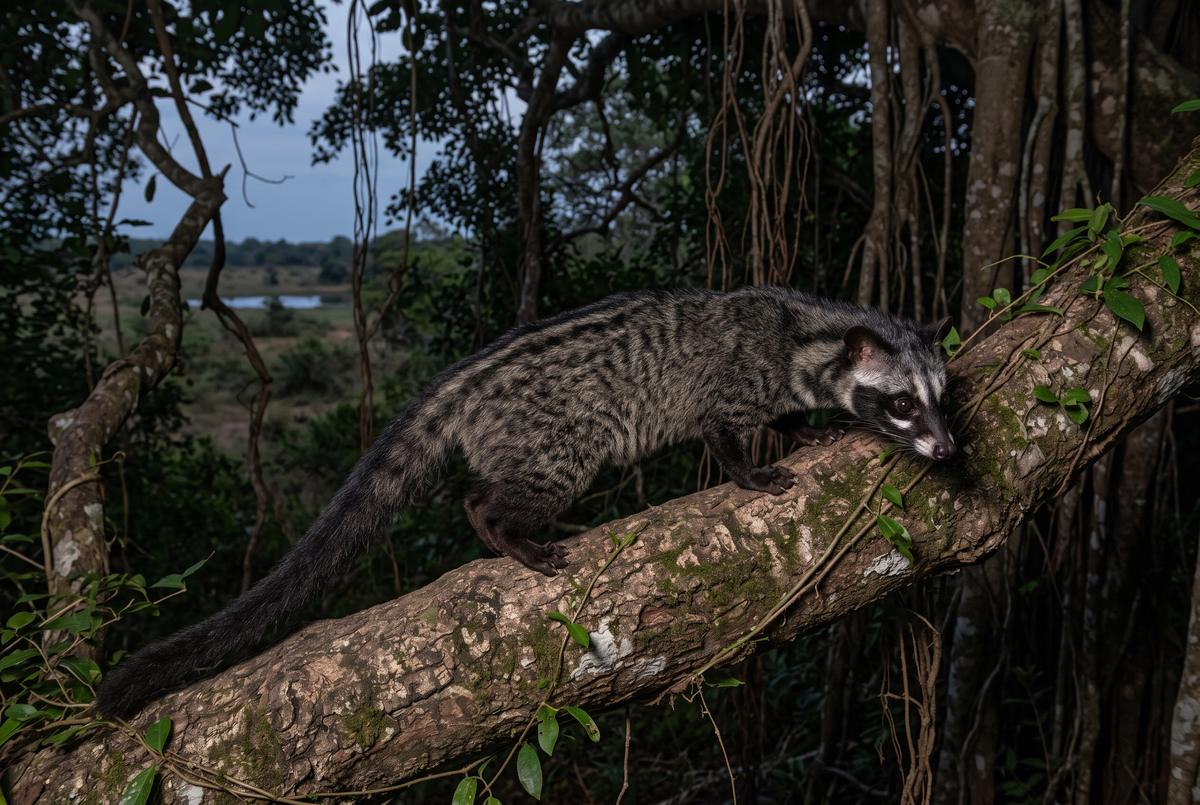
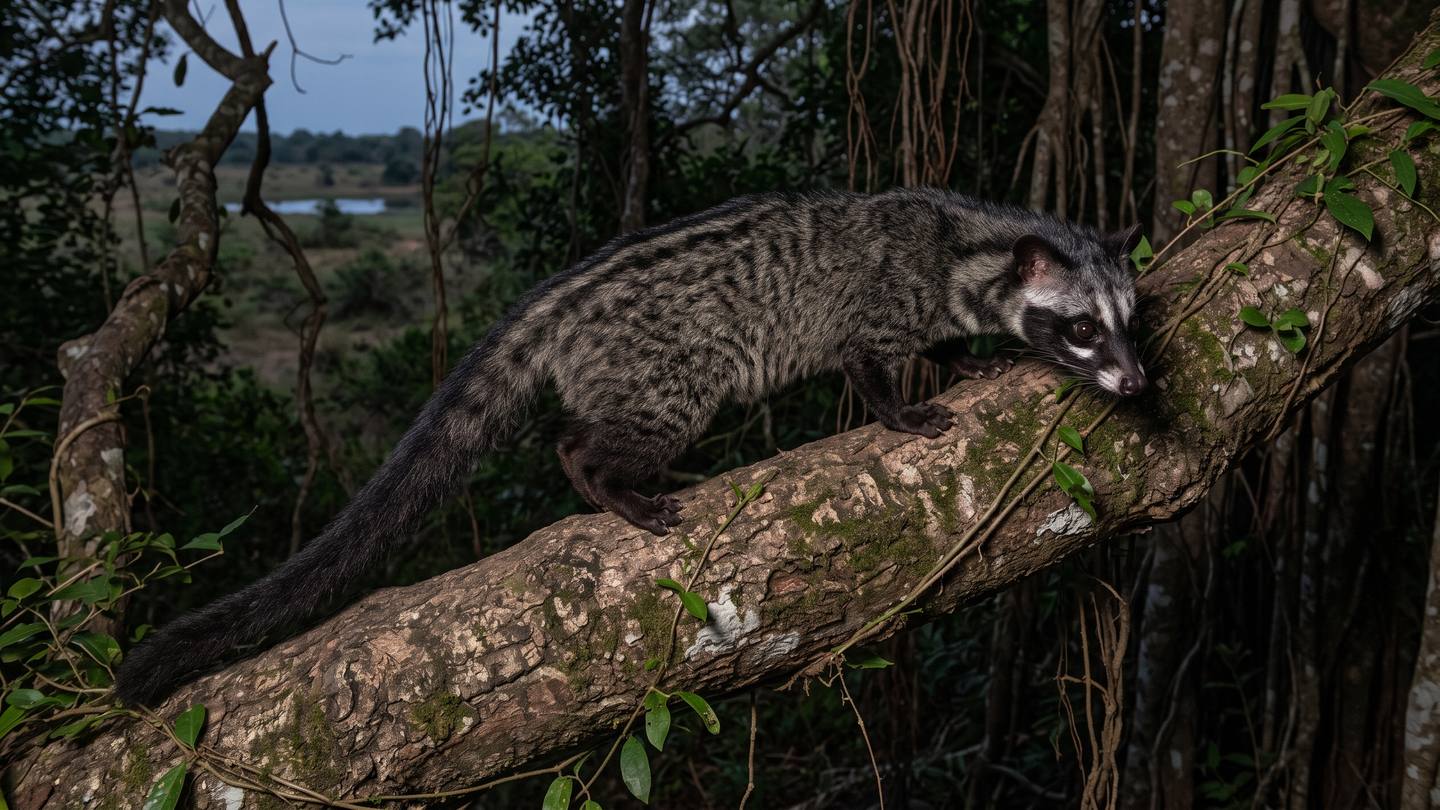
The toddy cat sits in the civet family alongside the ring-tailed civets and the small Indian civet, all built on the same basic plan: a long low body, a tail nearly as long as the trunk, short legs, and a pointed face that looks vaguely like a cross between a cat and a fox. Adults run to roughly a metre nose to tail, more than half of that being tail, and weigh around three kilograms, which is noticeably lighter than it looks when one is silhouetted along a branch at night.
The IUCN has listed it as Least Concern since 2008, and that assessment has held because the species does something most of Yala's more famous residents cannot: it thrives in disturbed habitat. Scrub jungle, home garden, coconut plantation, temple roof space, it is all usable territory to a palm civet. That adaptability is exactly why visitors underestimate it. It gets filed away as "just a civet" when in fact it is one of the better case studies in the park for how a generalist survives while specialists struggle.
The Toddy Cat Habit That Gave It the Name
Palm civets are excellent, confident climbers, and in parts of South Asia they earned their English nickname by raiding the clay pots that toddy tappers hang from palm trunks to collect fermenting sap. Whether that still happens inside Yala's boundaries is not something we can confirm, since there is no commercial toddy tapping within the park itself, but the behaviour pattern that produced the name is very much alive here: palm civets in Yala spend the dark hours moving through the canopy of kumbuk and palu trees along watercourses, and they will happily eat ripe, fermenting fruit when they find it, sometimes ending up visibly tipsy in the process, a detail that sounds like folklore but is well documented across the species' range.
Their diet otherwise is broad to the point of indifference: fruit, nectar, insects, small rodents, and the fermenting flesh of fallen jack and palu fruit along the tank edges. This dietary flexibility is part of why camera traps set up for leopard studies in Blocks I and II routinely pick up palm civets as incidental footage, night after night, in a way they never do for shyer species.
Where to Actually See One in Yala
Palm civets are almost completely nocturnal, which puts them outside the window of a standard half day or full day safari that runs roughly 6am to 10am and 2.30pm to 6.30pm. Most visitor sightings happen not on the jeep track but around accommodation: along the perimeter walls of bungalows near Buttuwa and Yala Safari Village, on the tin roofs near park entrance buildings at Palatupana during the dry season between roughly May and September, when water scarcity pushes smaller mammals closer to any lingering moisture, including tank margins and leaking taps around staff quarters.
If you are camping inside the park (see Camping in Yala National Park for the permit process), a torch swept low along the treeline after dark will often catch the double flash of a civet's eyeshine before you see the animal itself. They are not aggressive and will typically freeze, assess, and vanish rather than approach, so a sighting tends to last four or five seconds at most.
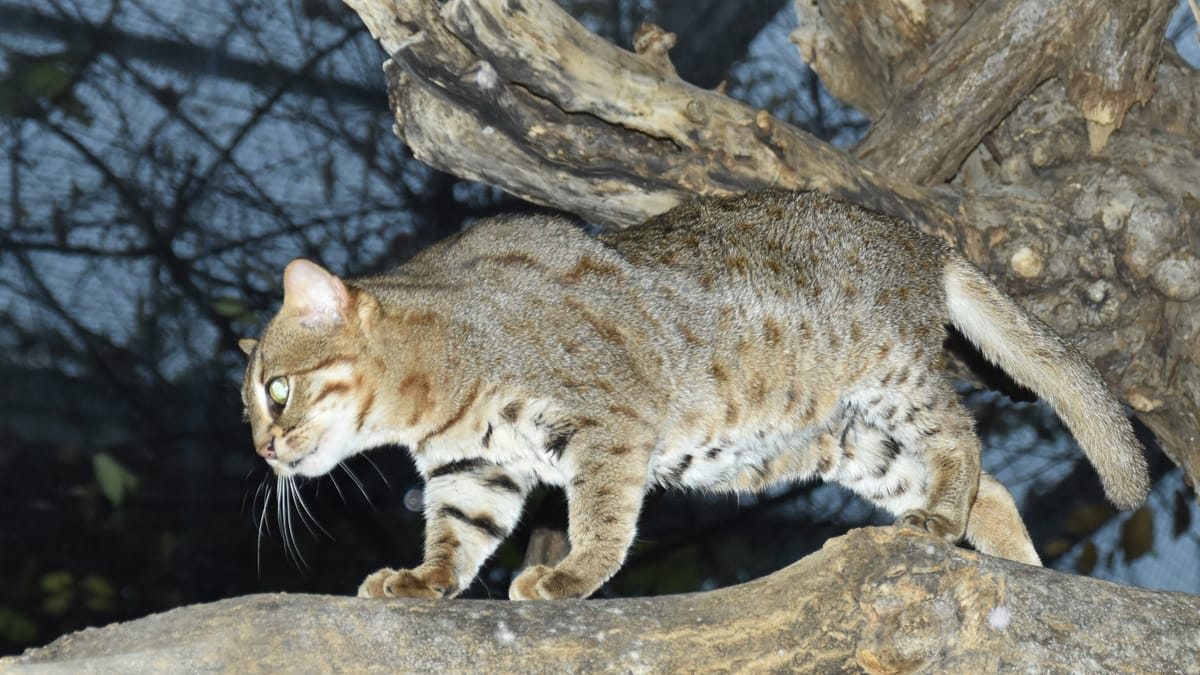
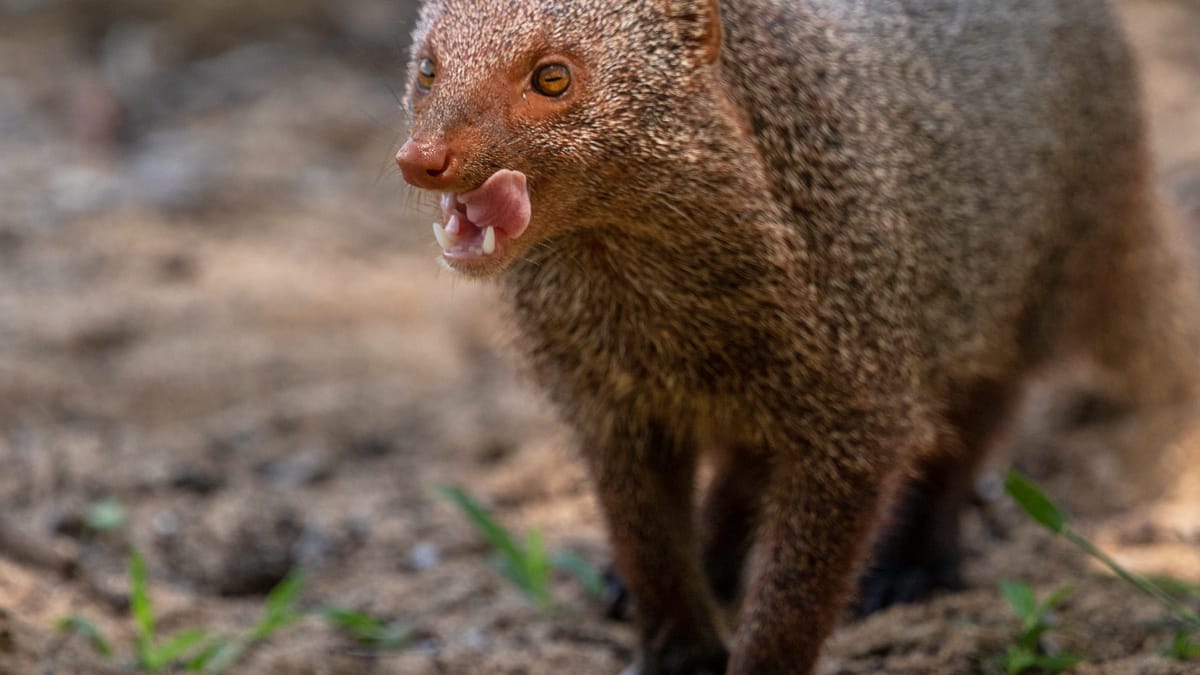
They are frequently confused with two other small nocturnal carnivores recorded in the park: the ruddy mongoose, which is diurnal and lacks the civet's long ringed tail (see The Ruddy Mongoose in Yala), and the much smaller, much rarer rusty-spotted cat, which is an actual felid and roughly a third the civet's size (see The Cat Smaller Than Your Kitchen Cat). Trackers distinguish them instantly by gait: the civet's back arches and dips as it moves, almost otter like, while both the mongoose and the small cat hold a flatter, straighter spine.
Scent Glands, Civet Coffee, and a Caution Worth Repeating
Palm civets carry perineal scent glands used for marking territory and, in captivity, those glands are the source of civet musk historically used in perfumery. The species is also the animal behind kopi luwak, the civet coffee sold at a premium because the beans are collected from civet droppings after the animal has eaten and partially digested coffee cherries. That industry has driven caged, intensive civet farming across parts of Southeast Asia, which is a welfare and conservation problem documented well outside Sri Lanka. We mention it here only because visitors sometimes ask whether Yala's civets are connected to it. As far as we can establish, there is no commercial civet coffee operation linked to Yala or its surrounding buffer zone, and any souvenir sold under that name near the park should be treated with scepticism rather than taken as a local product.
What "Least Concern" Actually Means Here
The Red List status is a global one, not a Yala-specific headcount. There is no published DWC population figure for palm civets inside the park, and we have not found one, so any number quoted to you on a jeep should be treated as a guide's estimate rather than a census result. What can be said with confidence is that the species shows no sign of local decline, that camera trap bycatch across both Block I and Block II suggests a dense and widespread presence, and that the main documented threat to the species regionally is poaching for the illegal wildlife trade, largely driven by that civet coffee and musk trade elsewhere in Asia rather than anything happening within Sri Lanka's protected area network.
For a park built around leopard sightings and elephant herds, the palm civet is a useful corrective. It is the animal doing fine while others make headlines, proof that resilience in Yala's ecosystem is not always about size, speed, or charisma. Sometimes it is about being willing to eat almost anything and sleep almost anywhere.
Sources
- Wikipedia, "Asian palm civet", https://en.wikipedia.org/wiki/Asian_palm_civet
- Department of Wildlife Conservation Sri Lanka
Ready to see it for yourself?
Book a safari