 YALA
YALA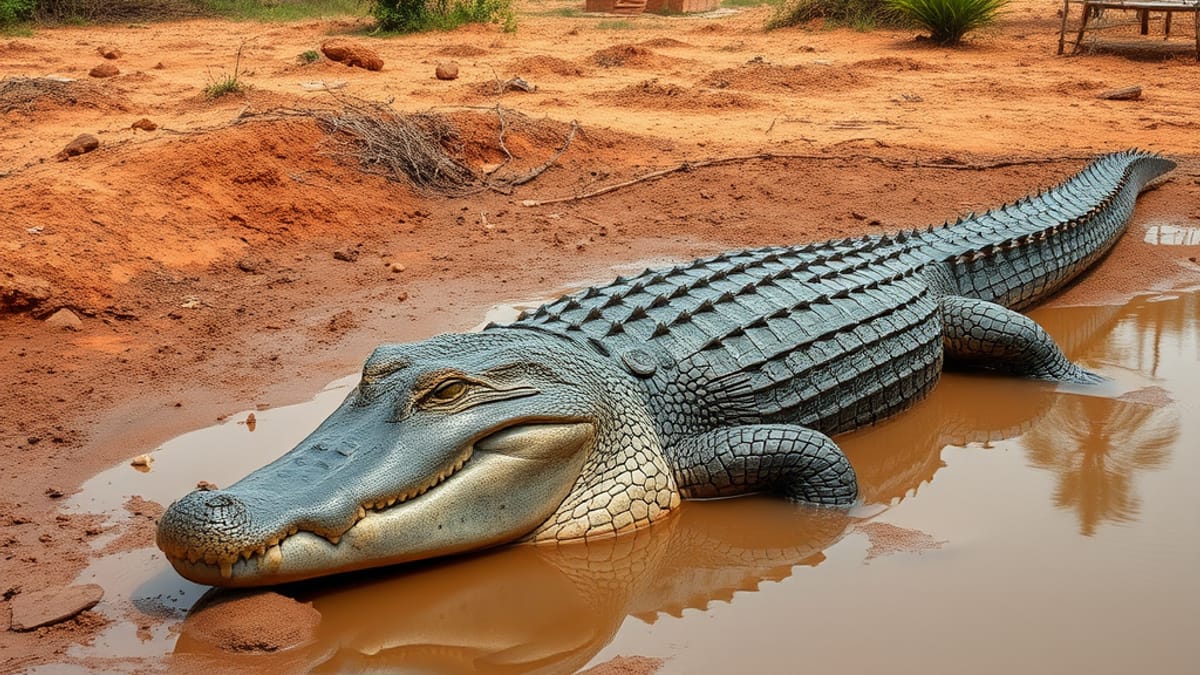
The Mugger Crocodile of Yala's Tanks
Everyone on safari is watching the tree line for a leopard. Meanwhile something considerably older, and arguably better at surviving Sri Lanka's dry season, is doing nothing at all on the mudbank six feet away. That's the mugger crocodile, and its stillness is not laziness. It's strategy.
Yala's tanks (the ancient irrigation reservoirs scattered through the park) are its stronghold. These aren't wild rivers so much as engineered waterbodies, some over a thousand years old, and the mugger has settled into them as comfortably as it once settled into the marshes and lakes of its native range from Iran through the Indian subcontinent.
Not the Crocodile You're Thinking Of
Sri Lanka has two crocodile species, and it's worth being precise about which one you're looking at. The saltwater crocodile turns up in estuaries and lagoons. The mugger is the tank and freshwater specialist, and it's the one you'll almost certainly see on a Block I or Block II safari.
The name has nothing to do with muggings. It comes from "magar," a Hindi and Urdu word for crocodile, and the species carries the more formal title Crocodylus palustris in the scientific literature. It's a broad-snouted, medium-sized crocodile as crocodilians go. Claims of individuals approaching 5 metres do exist, but that's close to the outer limit for the species, not a typical tank resident. Most of what you'll see in Yala is smaller and, frankly, harder to spot than the number suggests, since a mugger lying still in silted water is remarkably easy to mistake for a log.
It is also, evolutionarily speaking, not new to this. Fossil evidence puts the species' origins at well over four million years old, and it has featured in South Asian cultural and religious symbolism since the Vedic period, cast as a river deity's mount and a stand-in for the water's power to give life and take it away. Long before anyone built a lodge near Yala, this animal was already established business in the region's wetlands.
Built for the Dry Season, Not Despite It
The mugger's real skill is managing extremes, which happens to be exactly what a dry-zone park demands. When temperatures climb too high, or drop further than you'd expect in the tropics, muggers retreat into burrows dug into the bank. Both adults and younger animals do this, and it's one reason the species copes with Sri Lanka's dry season better than a casual visitor might assume, given how brutal that season gets. For context on just how harsh conditions turn during the driest months, and how the park itself responds, see DWC Sends Water Bowsers to Yala, Wilpattu, Kumana and Bundala as the Dry Season Bites. When the tanks shrink, the mugger is one of the animals best equipped to wait it out.
Nesting follows the dry season too. Females excavate holes in sandy banks and can lay a large clutch, reportedly up to around 46 eggs, though clutch size in practice varies a good deal by individual and habitat. What's genuinely interesting is that the sex of the hatchlings isn't fixed by genetics alone. Incubation temperature plays a role, a trait shared with several other reptile groups. Both parents stay involved afterward, guarding the young for as long as a year, which is a longer parental commitment than most visitors expect from a reptile.
Diet shifts with age. Hatchlings and juveniles take insects and small prey. Adults move up to fish, reptiles, birds and mammals, hunting mostly by ambush from still water rather than by chasing anything down. That ambush style is precisely why a stationary crocodile at a tank's edge deserves a longer look through the binoculars than most people give it.
A Vulnerable Species, Not a Common One
Despite how frequently visitors encounter muggers in Yala's tanks, the species as a whole is not doing well. It has been listed as Vulnerable on the IUCN Red List since 1982, and it's legally protected in Iran, India and Sri Lanka. Outside protected areas, muggers face habitat conversion, entanglement in fishing nets, conflict with people living near their wetlands, and road accidents. Yala's reservoirs, ironically because they're managed and monitored, function as something close to a stronghold for the species precisely because those outside pressures are largely absent within the park boundary.
So next time the leopard hasn't shown and the jeep idles by a tank, take the crocodile seriously. It's not a background prop. It's a species doing better here than almost anywhere else it's found, and that's worth some credit.
Sources
- Wikipedia, "Mugger crocodile", https://en.wikipedia.org/wiki/Mugger_crocodile
- Department of Wildlife Conservation Sri Lanka
Ready to see it for yourself?
Book a safari