 YALA
YALA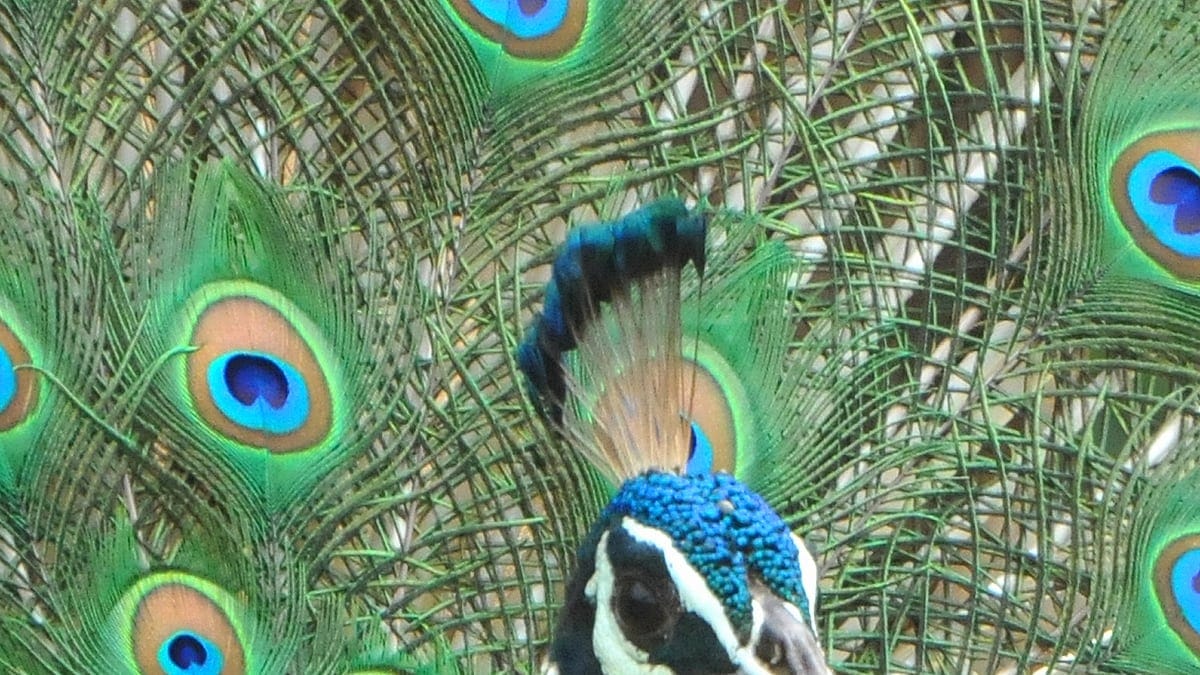
Yala's Peafowl Courtship Displays: The Dance Everyone Photographs but Nobody Explains
Everyone photographs the peacock. Almost nobody asks why he's doing what he's doing.
You've probably heard that he fans his train to "attract a mate," full stop, case closed. That's true in the way "the economy runs on money" is true. It tells you nothing about the mechanism. The mechanism, in this case, happened to stump Charles Darwin for years, and it's still not fully settled today. Which makes the birds strutting around Yala's tracks rather more interesting than most visitors realise.
What's actually on display
The bird itself is the Indian peafowl, Pavo cristatus, native to the subcontinent and, thanks largely to us, now found ornamentally on lawns from Miami to Melbourne. In Sri Lanka it needs no introduction and no cage. It's wild, common, and one of the most reliable sightings on any Yala safari.
The dimorphism between the sexes is extreme. The peacock carries a blue neck and head, a fan-shaped crest, and the famous train, not actually his tail feathers but elongated upper-tail coverts, each tipped with an iridescent eyespot. The peahen is a duller brown with a white face patch and a flash of iridescent green at the lower neck, and she carries no train at all. If you only ever notice one sex on safari, it's because one of them is built to be noticed.
Occasionally you'll hear a guide mention a white peafowl, a leucistic colour mutation that turns up in captive populations worldwide. Don't expect to see one in Yala. That's a domestic and zoo phenomenon, not a wild Sri Lankan one.
The display itself
When a peacock displays, he doesn't just raise the train, he turns it into a shivering wall of feathers facing the peahen, then rattles it with a rapid muscular tremor that produces an audible rustle, almost a hum, at close range. Guides sometimes call this "shivering" or "train-rattling," and it's a distinct behaviour from the visual fan itself: sound and shimmer, aimed at a female who is, more often than not, apparently ignoring him entirely and pecking at the ground.
Displaying peacocks tend to cluster on open ground, forest edges, and cultivated margins, exactly the habitat Yala offers in abundance around its tank bunds and scrub clearings. Multiple males may display within sight of each other, a loose arrangement biologists call a lek, though Indian peafowl leks are less rigidly structured than the classic examples in other bird species. The peahen wanders through, inspects several males, and makes her choice. What she's actually judging is the part nobody has fully agreed on.
Why Darwin lost sleep over this
Darwin found the peacock's train genuinely troubling. Natural selection is supposed to strip away anything costly and useless. A train that's heavy, metabolically expensive to grow every year, and presumably a hindrance against a predator should have been selected out generations ago. Instead it got more elaborate. Darwin's eventual answer was sexual selection: if females consistently prefer more elaborate trains, then the trait spreads regardless of its survival cost, because reproductive success and survival aren't the same currency.
That idea is now mainstream evolutionary biology, but the specifics remain argued over. In the twentieth century, the biologist Amotz Zahavi proposed the handicap principle: the train is expensive precisely so it can't be faked. Only a genuinely fit male can afford to carry that much dead weight and still survive to display it, so the ornament becomes an honest, hard-to-counterfeit signal of quality. Other researchers have pushed back, pointing out that some field studies find eyespot number barely correlates with female choice at all. Despite well over a century of study, including detailed work on wild and feral peafowl populations, nobody has produced a single explanation that fully satisfies everyone. We're not going to pretend otherwise. If a source tells you the science is settled, be sceptical.
Season, timing, and what you'll actually see in Yala
Display intensity in Indian peafowl tracks the breeding season, which in Sri Lanka runs broadly through the first half of the year, with activity building noticeably from around January and peaking through the pre-monsoon months into April and May. This is worth knowing because it overlaps well with Yala's main dry-season visiting window discussed in When to Visit Yala, so you don't need to trade off leopard conditions against peafowl theatre. Outside the breeding peak, males still carry the train for much of the year but display far less, and the train itself is moulted and regrown annually, so late-season visitors may find some males looking distinctly ragged.
Early morning, near water, is the reliable formula. Peafowl forage on the ground for grain, berries, and small prey including lizards and snakes, and they favour the open scrub and forest-edge mosaic found through Block I around tank margins and cultivated clearings, terrain covered in more detail in The Leopards of Block I. Despite the size of that train, the bird flies perfectly well and roosts high in trees at night, dropping down at dawn to feed and, in season, to display.
Their alarm calls are also worth learning to listen for, not just admire visually. A sharp, repeated peafowl call is one of the standard predator-alert sounds trackers use in the field, alongside spotted deer and langur alarms, when trying to pin down a moving leopard. A bird that looks purely decorative is, functionally, part of Yala's early-warning system.
Sources
- Wikipedia, "Indian peafowl", https://en.wikipedia.org/wiki/Indian_peafowl
- Department of Wildlife Conservation Sri Lanka
Ready to see it for yourself?
Book a safari