 YALA
YALA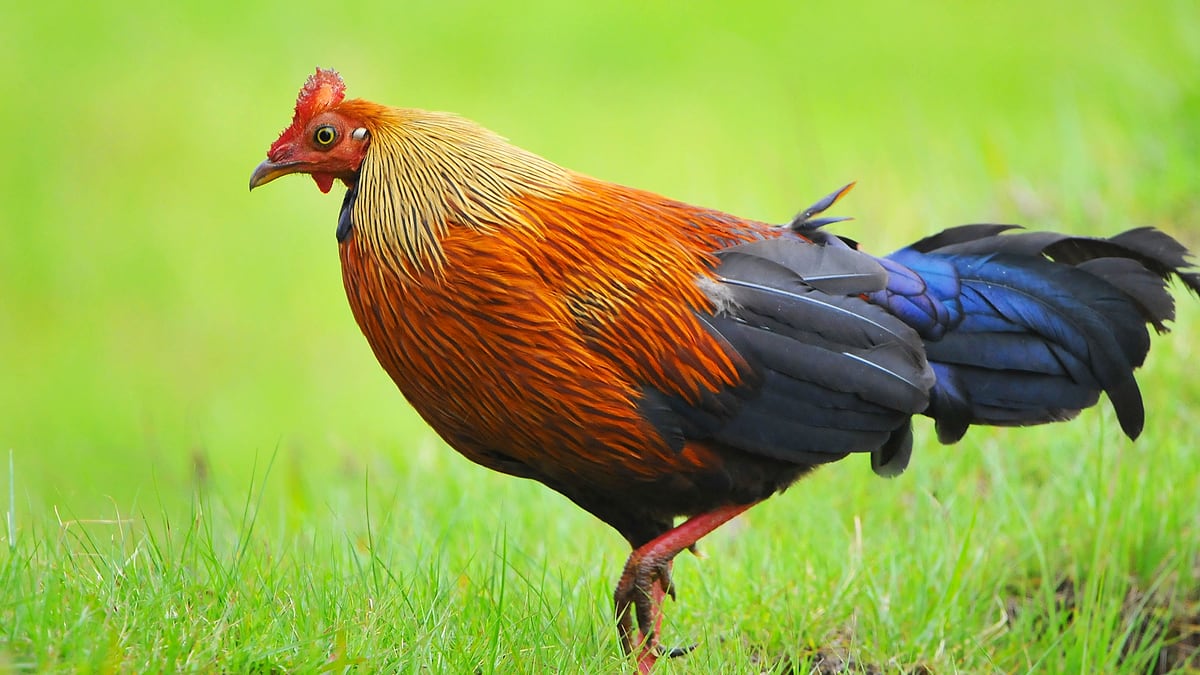
The Bird Everyone Photographs by Accident
You've probably heard that the junglefowl in Yala is "just a wild chicken." We checked. That description is not wrong exactly, but it undersells a bird with a genuinely interesting family tree and a title most visitors never learn it holds: national bird of Sri Lanka.
Almost every jeep in Yala rolls past a Sri Lankan junglefowl within the first ten minutes. Almost nobody stops for it. Cameras stay pointed at the treeline for leopards, or up at the sky for painted storks. Meanwhile a bird found nowhere else on Earth scratches around in the dust by the track, largely ignored.
Not Just a Wild Chicken
The comparison to chickens is not lazy, it is genealogical. The Sri Lankan junglefowl, scientifically Gallus lafayettii, belongs to the same bird order as domestic poultry and sits close to the red junglefowl, the species from which chickens were originally domesticated. Genetic estimates put the split between the Sri Lankan and red junglefowl lineages at around 2.8 million years ago.
Here is the detail the brochures tend to skip: Sri Lanka's junglefowl is actually a closer relative of the grey junglefowl of India, with that split dated to roughly 1.8 million years ago, a full million years more recent than its divergence from the red junglefowl. So the "wild chicken" story is true, but the closer cousin isn't the one everyone assumes.
There is a stranger twist still. Researchers have found evidence of introgressive hybridization, meaning Sri Lankan junglefowl genes have worked their way into domestic chicken populations somewhere along the historical line. In other words, that bird crossing the road in front of your jeep may have distant descendants living in farmyards elsewhere in the world.
A Name From the French Revolution
The species name lafayettii honors Gilbert du Motier, the Marquis de La Fayette, the French aristocrat and general better known for his role in the American and French revolutions than for Sri Lankan ornithology. Why his name ended up attached to this particular bird is one of those quirks of nineteenth century naming conventions that history does not fully explain, at least not in any source we are confident citing here. What is certain is that the connection to Sri Lanka itself is purely nominal. The bird's entire natural range, its endemism, and its cultural status all belong to the island alone.
Endemic is doing real work in that sentence. Unlike the elephants, leopards and crocodiles that draw the crowds and that also live, in related forms, elsewhere in Asia, the Sri Lankan junglefowl exists only here. See one in Yala and you have seen the entire species in its only home. There is no equivalent sighting to be had in India, Africa or anywhere else.
Where and When to Actually Look
Junglefowl are common across Yala's drier scrub and open woodland, which means Block I sightings are routine and rarely worth a special detour on their own (for the animals worth a detour in that block, see The Leopards of Block I). Males are the ones people notice, with a rooster-like silhouette, dark plumage and a orange-red neck, and a distinctive yellow patch at the centre of the comb that separates them at a glance from any farmyard bird. Females are quieter in colour and easy to overlook entirely, which is presumably why so many visitors assume they have only seen one bird when they have seen two.
Early morning game drives tend to produce the clearest views, since junglefowl are most active foraging on the ground before the day heats up, a pattern that lines up with the general wildlife activity patterns covered in When to Visit Yala. They favour forest edges and scrub bordering open ground rather than deep jungle, so drivers moving slowly along track margins give you a far better chance than anyone rushing toward a leopard alarm call.
None of this requires planning a trip around. But it does mean that on every single Yala safari, somewhere among the animals you photograph without quite meaning to, sits a species that exists nowhere else on the planet, carries a French revolutionary's name, and quietly helped write the genetic history of the chicken on your dinner plate.
Sources
- Sri Lankan junglefowl, Wikipedia (https://en.wikipedia.org/wiki/Sri_Lankan_junglefowl)
- Department of Wildlife Conservation Sri Lanka
Ready to see it for yourself?
Book a safari