 YALA
YALA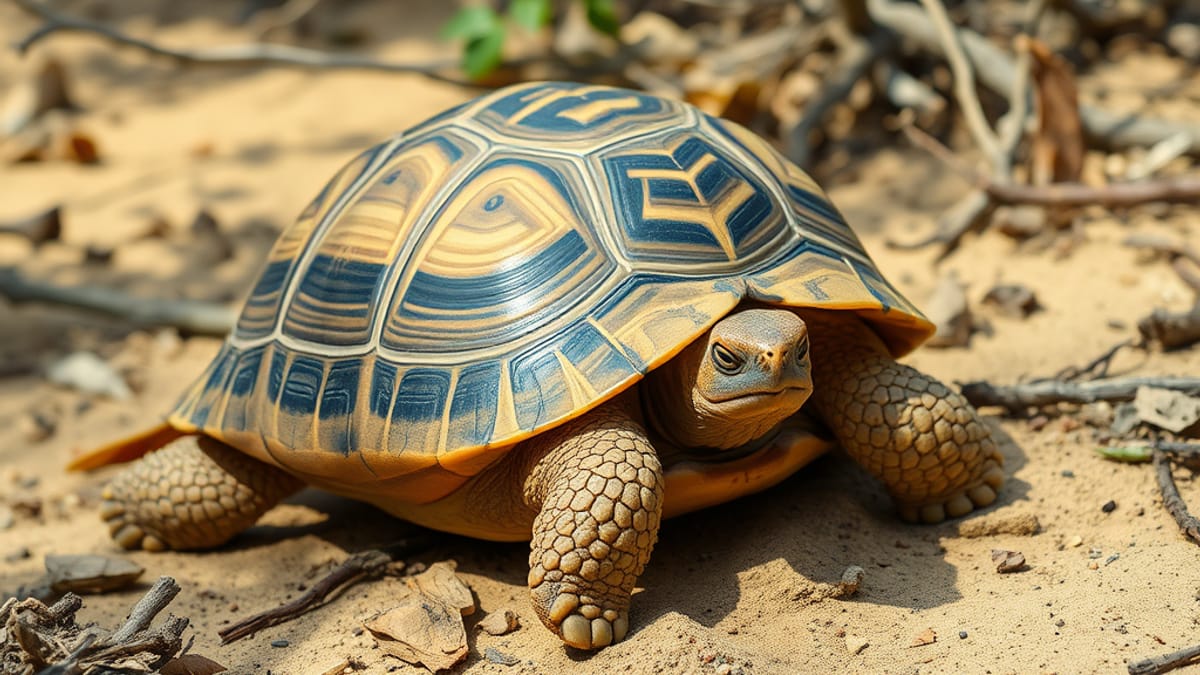
The Sri Lankan Star Tortoise in Yala
Ask most visitors what they came to Yala for and you'll hear leopard, elephant, maybe sloth bear if they've done their homework. Almost nobody says tortoise. Which is a shame, because the animal shuffling through the scrub near your jeep might be one of the more quietly remarkable residents of the park, and one that international wildlife law now treats as seriously as anything with claws.
The species is the Indian star tortoise, Geochelone elegans, and despite the name it is very much a Sri Lankan animal too, alongside populations in India and Pakistan. It favours exactly the kind of dry scrub and thorn forest that makes up much of Yala's terrain, which is one reason the park is a genuinely good place to look for one rather than just a place where one happens to occasionally turn up.
The Shell Is the Whole Story
The star pattern isn't decoration in the way a leopard's rosettes are decoration for a photographer. Each scute (the horny plate on the shell) carries radiating yellow lines on a dark background, and the effect is a dome that looks lit from within, almost architectural. It is also camouflage of a very specific kind: broken up against dry leaf litter and dappled shade, a still tortoise disappears far more effectively than its striking pattern would suggest from a photograph.
That same beauty is the reason the species is in trouble. A wild-caught star tortoise, with its shell pattern intact and undamaged, has long been prized in the international pet trade. The animal's defence, being slow, hard-shelled and easy to pick up, is precisely what has made it so easy to poach.
What "Vulnerable" Actually Means Here
The IUCN Red List has classified the Indian star tortoise as Vulnerable since 2016. The global population is thought to number more than 10,000 individuals, but the trend line is downward, driven by habitat loss and by collection for trade rather than any natural pressure. That is worth sitting with for a moment: this is not a species clinging on in the tens or hundreds, but one that is still, in absolute terms, reasonably numerous and still losing ground.
The trade side of the problem is not abstract. The conservation group TRAFFIC has documented over 6,000 star tortoises (6,040, to use their figure) seized worldwide, all intended for the pet market. In 2019, CITES member states agreed by full consensus to move the species to Appendix I, the strictest tier of international protection, which bans commercial trade in wild-caught individuals outright. That level of unanimous agreement among CITES parties is rare, and it tells you how clearly the evidence for decline had stacked up by then. Ironically, the species is now also bred in captivity in several countries specifically for the pet trade, which muddies enforcement: a captive-bred animal and a smuggled wild one can look identical in a shipping crate.
Where to Actually Look in Yala
Star tortoises are creatures of the dry, open scrub rather than the wetlands, so the areas around Palatupana and the drier stretches of Block I, away from the tank margins, are where sightings are more likely than along the lagoon edges favoured by crocodiles and waterbirds. They are most active during the cooler parts of the day, early morning and late afternoon, and effectively disappear from view during the peak heat of midday, when they retreat into shade or leaf litter and simply stop moving.
Seasonally, the dry months from around June through September in Yala's cycle push them toward whatever moisture remains, so encounters near seasonal pools or the margins of scrub clearings tend to pick up. The short window after the northeast monsoon rains, roughly December into January, also produces more visible activity, as the tortoises take advantage of softer ground and fresh growth after the dry months. None of this is a guarantee. Unlike leopards, which have territories jeeps can learn and trackers can predict, a tortoise's whereabouts on any given morning is close to random, and most sightings in Yala are a matter of a sharp-eyed tracker noticing a shape in the leaf litter rather than a planned approach. For a broader sense of how the park's rhythms shift across the year, see When to Visit Yala.
Slow, But Not Simple
It is easy to underestimate an animal that moves at the pace a star tortoise does, but the biology is not as basic as "slow reptile in a shell." They are herbivorous grazers, taking grasses, fallen fruit and some flowers, and their digestion is built around extracting what little moisture and nutrient value dry-season vegetation offers. Growth is slow and so is reproduction: clutches are modest and hatchlings are vulnerable to almost everything in the park's food chain, from mongoose to monitor lizard, long before they grow into a shell hard enough to matter.
That slowness cuts both ways for conservation. It means population recovery, once numbers drop, takes far longer than for a fast-breeding species. It also means the animals you do see in Yala are very likely mature adults that have survived years of exactly the pressures, drought, predation and historically, poaching, that the species faces across its range. A star tortoise crossing a track in front of your jeep has, in a small way, already beaten the odds.
Why This Matters Beyond the Sighting
It's tempting to file the star tortoise under "nice to see, not essential," next to peafowl and junglefowl, but that undersells its role. As a slow-moving, ground-level grazer, it shapes small patches of vegetation and disperses seeds through its droppings across distances that faster animals cover in minutes but that represent, for a tortoise, days of travel. Losing it from a landscape doesn't announce itself the way losing a leopard would. It just quietly changes what grows where.
Yala's protection of this habitat, imperfect and pressured as it is by visitor numbers and encroachment at the margins, is part of why the species still has a stronghold here at all. Whether that holds depends less on any single safari sighting and more on the same slow, unglamorous work: habitat kept intact, trade routes kept closed, and a park that keeps being a place where a tortoise can cross a track and simply be a tortoise, rather than cargo.
Sources
- Wikipedia, "Indian star tortoise", https://en.wikipedia.org/wiki/Indian_star_tortoise
- Department of Wildlife Conservation Sri Lanka
Ready to see it for yourself?
Book a safari