 YALA
YALA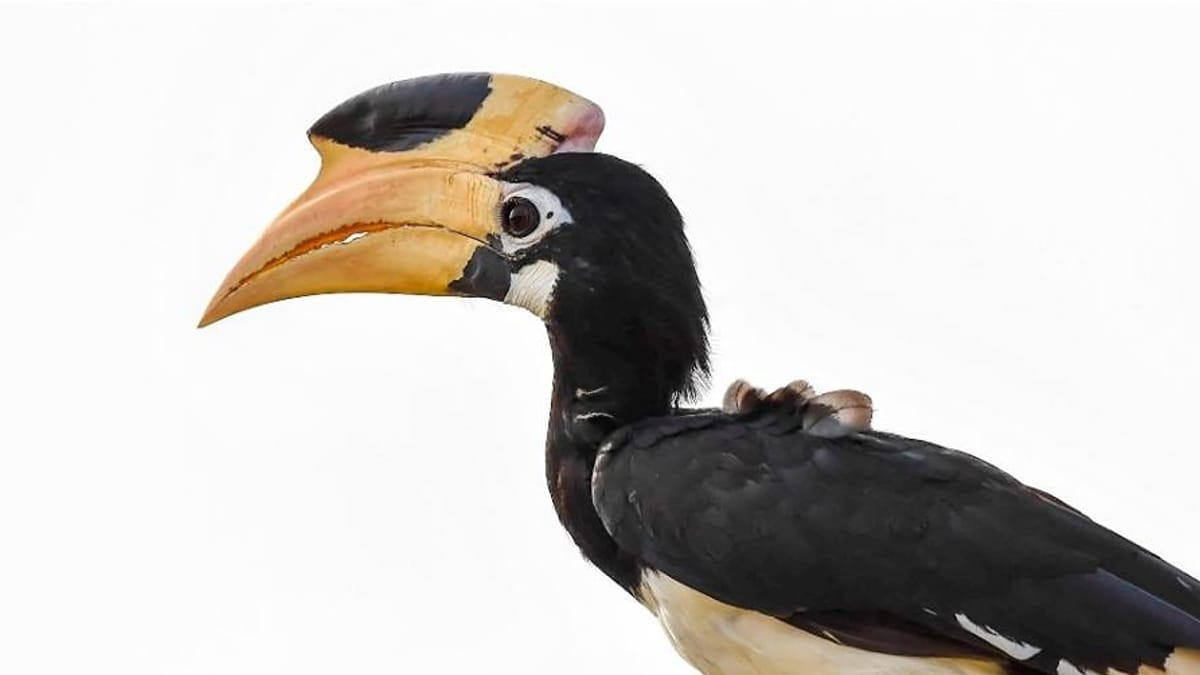
Image: Gihan Jayaweera · Wikimedia Commons (CC BY-SA 3.0)
Yala's Two Hornbills: Grey and Malabar Pied, and How to Tell Them Apart
Most first-time visitors to Yala are listening for alarm calls and scanning rocks for leopards. Few are looking up into the canopy for a bird with a casque on its beak. That's a shame, because Yala has two hornbill species, and they could not be more different from each other.
One is small, grey, plain-looking and endemic to Sri Lanka. The other is large, boldly pied in black and white, and shared with mainland India. Guides sometimes mention "hornbill" as a single tick-box item on a sighting sheet. It isn't. These are two separate birds with separate stories, and mixing them up means missing what makes each one interesting.
The Sri Lankan Grey Hornbill: small, endemic, easy to overlook
The Sri Lankan Grey Hornbill (Ocyceros gingalensis) is one of the island's endemic birds, meaning it occurs nowhere else in the world. It's a modest-sized hornbill, roughly crow-sized, grey-brown overall with a pale bill that lacks the huge casque of its larger cousins. That plainness is exactly why visitors walk past it. There's no dramatic profile to catch the eye, no flash of colour. It moves through the mid-canopy of scrub and dry forest in small, chattering groups, often heard before it's seen.
The call is a useful giveaway: a nasal, cackling series that carries through dry-zone thorn scrub, quite different from the deeper honking of larger hornbills elsewhere in Asia. If a guide suddenly slows the jeep and tilts their head rather than their camera, it's often this call they've picked up on.
Diet is mixed. Figs and other forest fruits form the backbone, supplemented with insects, small lizards and the occasional nestling of other bird species when the opportunity arises. This opportunism is fairly typical of hornbills generally, and it means Grey Hornbills are often found near fruiting trees rather than distributed evenly across the park.
Breeding behaviour is the species' most striking trait, and it's shared with hornbills worldwide: the female seals herself into a tree cavity using mud, droppings and food debris, leaving only a narrow slit through which the male passes food during incubation. She only breaks out once the chicks are partly grown. It's a strange, vulnerable-looking strategy that actually protects the nest from snakes and monitor lizards, both of which are well represented in Yala's undergrowth (see our piece on the water monitor lizard for a sense of how real that predation pressure is).
Because the species is endemic and reasonably common in the right habitat, it doesn't carry the same conservation urgency as some of Yala's rarer residents. But "reasonably common" still depends on being in dry-zone scrub forest with mature trees for nesting cavities, which is a narrower requirement than it sounds.
The Malabar Pied Hornbill: bigger, louder, harder to miss
The Malabar Pied Hornbill (Anthracoceros coronatus) is a different proposition entirely. This is a genuinely large bird, black above and white below, with a heavy yellow and black casque sitting on top of an already substantial bill. In flight, the wingbeats produce an audible whooshing sound, a trait common to large hornbills and one that often alerts observers before the bird is visually located.
Unlike the Grey Hornbill, the Malabar Pied is not endemic to Sri Lanka. It's shared with India, particularly the drier forests of the subcontinent, and its Sri Lankan population sits at the eastern edge of that broader range. It tends to favour taller riverine forest and areas near water sources more than the driest thorn scrub, which makes sense given its size and the larger fruiting trees it depends on.
Within Yala, sightings cluster around areas with taller gallery forest and permanent water, the kind of habitat found along parts of the Menik Ganga corridor and around some of the larger tanks. Exact numbers for the Yala population aren't publicly tracked in the way, say, elephant or leopard numbers are, so it's worth being cautious about any specific count you hear quoted. What's well established is that it's less frequently encountered than the Grey Hornbill on an average half-day safari, partly because its preferred habitat is a smaller slice of the park's total area.
Nesting behaviour mirrors the Grey Hornbill's sealed-cavity strategy, but the scale is bigger. Malabar Pied Hornbills need genuinely large, mature trees with cavities wide enough for their bulk, which ties their breeding success directly to the availability of old-growth forest patches rather than scrub regrowth. This is one reason hornbill conservation globally tends to focus heavily on protecting large old trees, not just forest cover in general.
Where and when you're likely to see either
Timing and location matter more for hornbills than for most of Yala's headline mammals. Fruiting cycles in dry-zone forest are seasonal and somewhat unpredictable year to year, so a fig tree that was busy with Grey Hornbills last month might be quiet next month, while a different tree along the route suddenly draws a flock.
That said, general patterns hold. The cooler, greener months following the northeast monsoon (broadly November through into the earlier part of the year) tend to support more fruiting activity across the dry zone, which in turn concentrates hornbill activity around productive trees. Later in the dry season, when much of Block I's vegetation thins out and water sources shrink, birds of both species tend to draw closer to the remaining tanks and riverine strips, which is worth reading alongside our season guide if you're planning a trip specifically with birding in mind.
Block I, being the most visited and most thoroughly mapped section of the park, is where the majority of confirmed hornbill sightings happen simply because it has the most jeep traffic and the most experienced trackers passing through daily. That doesn't mean the birds are absent from Block II or the park's other blocks, only that fewer observers are there to log them.
Why two hornbills matter for one park
It's easy to treat "hornbill" as a single line on a checklist, but having both an endemic small species and a widespread large species in the same park says something about Yala's habitat range. The Grey Hornbill's comfort in dry thorn scrub and the Malabar Pied's preference for taller riverine forest reflect the genuine variety packed into a park that, from a jeep window, can look like a fairly uniform stretch of dry-zone bush.
For visiting birders, the practical takeaway is simple. Don't wait for a dramatic flypast. Listen for the Grey Hornbill's cackling chatter in scrub sections, and watch for the heavier wingbeat sound of the Malabar Pied near water and taller trees. Both are legitimate, worthwhile sightings, and neither requires the sort of luck that a leopard or a sloth bear sighting does.
Sources
- Department of Wildlife Conservation Sri Lanka
- General ornithological knowledge of Sri Lankan endemic and resident bird species (IUCN species accounts and standard South Asian bird field guide consensus)
Ready to see it for yourself?
Book a safari