 YALA
YALA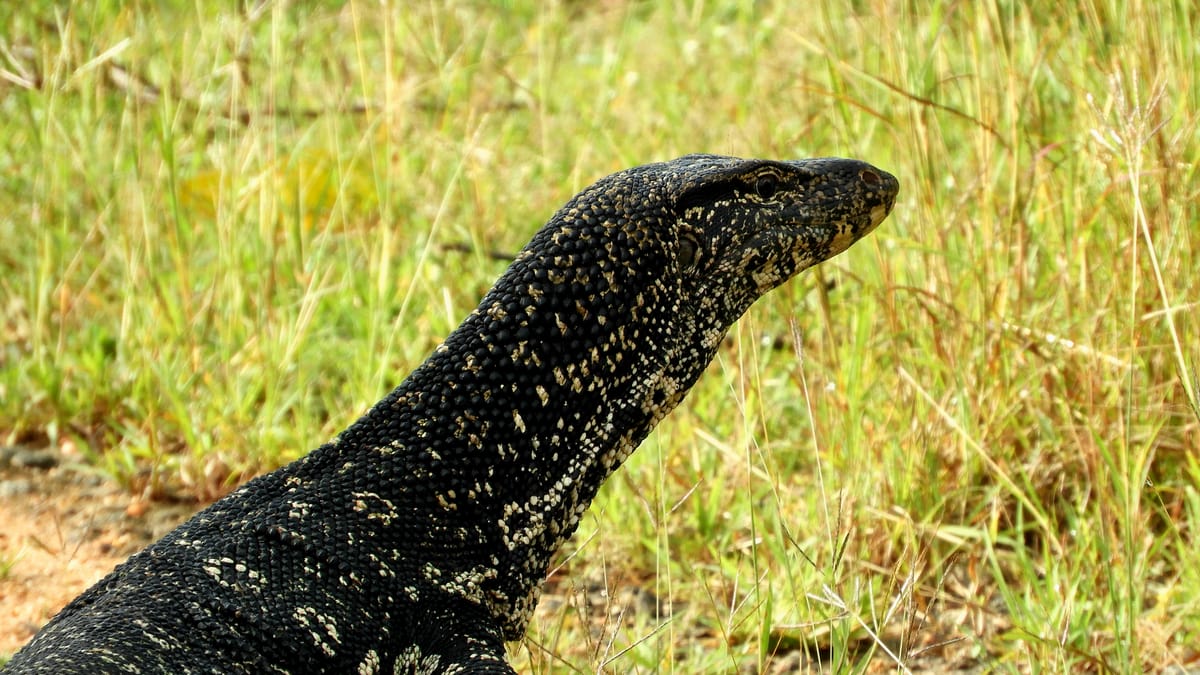
Image: Azardwiki · Wikimedia Commons (CC BY-SA 4.0)
Yala's Water Monitor Lizard: The Second-Largest Lizard on Earth Is Probably Ignoring You
You've probably heard water monitors called "land crocodiles" by a guide trying to make you look twice. They're not crocodiles. They're not even close relatives. They're lizards, and they happen to be the second-largest lizard species on the planet, beaten only by the Komodo dragon. That's not a brochure exaggeration. It's the actual taxonomic ranking.
In Yala, you'll see them constantly, which is precisely why people stop seeing them. A monitor hauling itself across the track near a tank, or lying half-submerged with just its nostrils and eye ridges above the waterline, gets a glance and a "oh, just a lizard" from the back seat. That reaction says more about tourist expectations than about the animal.
What You're Actually Looking At
Varanus salvator is built like a survival machine that happened to evolve scales. Adults regularly reach 1.5 to 2 metres nose to tail, and old individuals in good habitat can push past that. The tail alone can be as long as the body, flattened side to side like a rudder, which tells you everything about how this animal makes its living.
It swims. Genuinely well, not just "can wade if it has to." The tail drives it through water with an eel-like sweep, and it can stay submerged for extended periods when it wants to avoid something. This is not an animal caught between two worlds, land and water. It's an animal that treats both as home turf, which is a rarer trick among reptiles than people assume.
The range backs this up. Water monitors are found from northeastern India and Bangladesh through the Andaman and Nicobar Islands, across Sri Lanka, into southern China and Hainan, and on through Mainland Southeast Asia into Sumatra, Borneo, Java and beyond. It's one of the most widely distributed monitor lizard species alive, and Sri Lanka's dry zone tanks and rivers sit comfortably within that range rather than at its edge.
Why Yala Suits It So Well
Yala's tank network exists because of an ancient irrigation civilisation, not because of wildlife tourism, but the monitors don't care about the history. What they care about is that a chain of bunds, tanks and the Menik Ganga river system gives them exactly the mosaic of still and moving water they need, right next to thick scrub for cover.
Watch one hunting and the opportunism becomes obvious. Fish, frogs, crabs and other invertebrates make up the bulk of the diet, but a monitor will just as happily take eggs from an unguarded nest, scavenge a carcass, or work the edge of a waterbird colony looking for a chick that strayed too far. If you've read our piece on the painted stork colonies of Yala's wetlands, you'll already know these nesting sites draw predators as reliably as they draw birdwatchers, and the water monitor is one of the quieter ones working that margin.
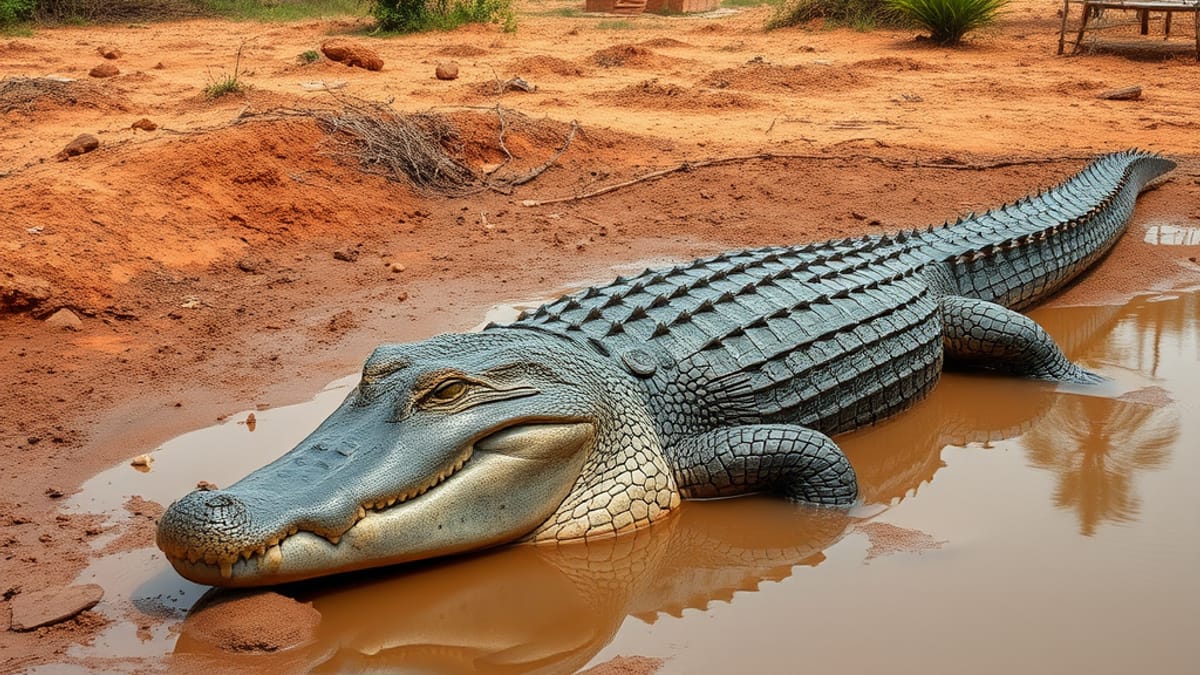
They also share water with Yala's other big reptile, the mugger crocodile, and the two rarely come into direct conflict despite overlapping habitat. Muggers ambush from the water; monitors forage on land and in water both, moving in and out of the tank edges in a way crocodiles generally don't. For more on the tank system's other apex reptile, see The Mugger Crocodile of Yala's Tanks.
Seasonal Behaviour Worth Knowing
Sightings shift noticeably between the wet and dry months. During the dry season, roughly May through September when Yala's smaller waterholes shrink or vanish entirely, monitors concentrate hard around the tanks and the river that still hold water. This is exactly the period covered in our piece on DWC sending water bowsers into Yala, Wilpattu, Kumana and Bundala as the dry season bites, and the same shrinking water points that draw elephants and deer to bowser-fed troughs also concentrate monitor activity around whatever natural water remains.
In the wetter months, roughly November through January, the lizards disperse more widely as temporary pools and flooded grassland open up fresh hunting ground, and sightings along the main tracks can actually drop simply because the animals have more places to be. If your priority is monitor sightings specifically, the dry season concentration around permanent water bodies works in your favour, a detail that ties into the broader planning advice in When to Visit Yala.
Nesting is another seasonal marker. Females dig burrows or use termite mounds to lay eggs, exploiting the steady temperature inside an active or abandoned termite nest as free incubation. This isn't unique to Sri Lankan populations, it's documented water monitor behaviour across much of the species' range, and Yala's abundant termite mounds make it a plausible and frequently reported nesting strategy here too, though we'd flag that precise nesting timing data specific to Yala's population isn't something we can state with full confidence.
Common Misreadings, Corrected
You've probably heard that water monitors are dangerous to humans in the way crocodiles are. We checked against what's actually documented: they are not pursuit predators of large mammals, they lack the crocodile's ambush bite force and drowning strategy, and confirmed serious attacks on people are rare and generally defensive, not predatory. Give one space and it will almost always choose to leave.
You've probably also heard them dismissed as "just scavengers," implying they're somehow less impressive than a predator that hunts. That undersells the animal. A water monitor is an active hunter of fish, frogs and invertebrates as well as an opportunist at carcasses and nests, which is a broader and arguably more successful survival strategy than specialising in one prey type.
On conservation status, the picture is genuinely reassuring rather than something we need to soften. The IUCN currently lists the Asian water monitor as Least Concern, on the strength of a large, stable, wide-ranging population across South and Southeast Asia. Unlike several of Yala's more fragile residents, this is not a species anyone needs to worry about disappearing.
What to Actually Look For on Safari
Check the tank edges first, particularly where mud gives way to reed or grass cover, since monitors bask there in the early morning and late afternoon when the sun angle is low and the ground has cooled enough to be comfortable. A raised head with a forked tongue flicking in and out is the giveaway; that tongue-flick is a chemical sense, not a threat display, closer to a snake's tasting of the air than anything aggressive.
Don't ignore the ones on dry track either. A monitor crossing open ground between water sources moves with a rolling, almost prehistoric gait that's genuinely worth a photo, and it's a useful reminder that this lizard's territory in Yala extends well beyond the obvious wet patches on the map.
Sources
- Asian water monitor, Wikipedia, https://en.wikipedia.org/wiki/Asian_water_monitor
- Department of Wildlife Conservation Sri Lanka
Ready to see it for yourself?
Book a safari