 YALA
YALA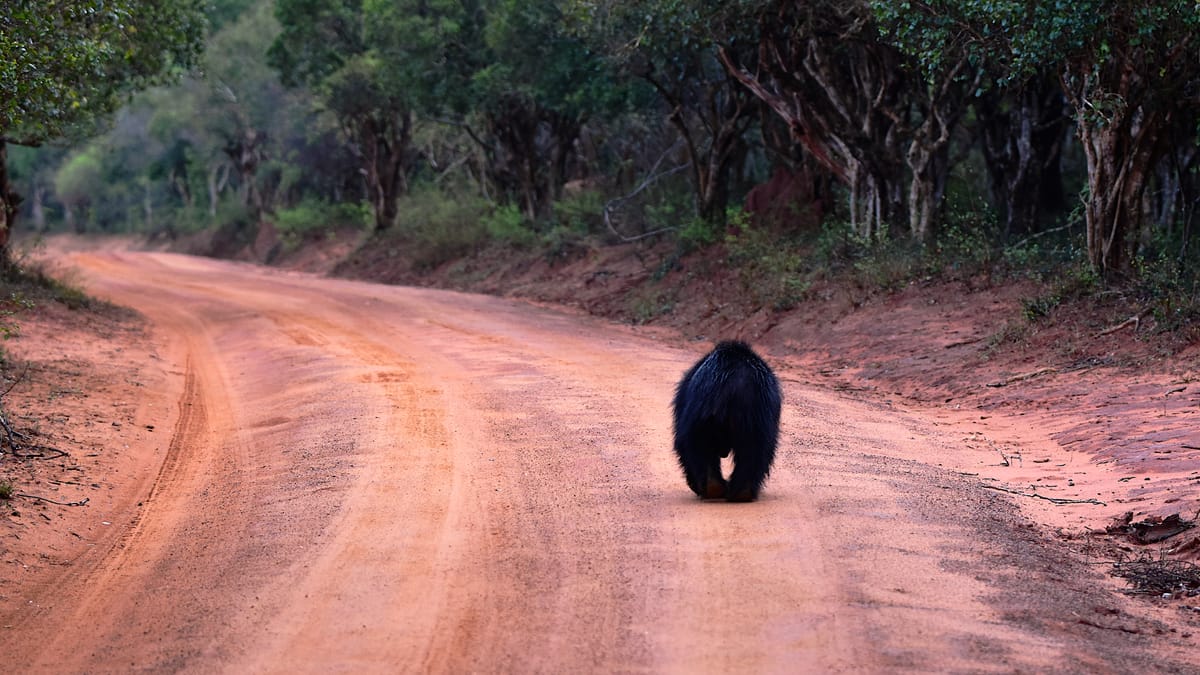
Image: Aruna Dissanayake · Wikimedia Commons (CC BY-SA 4.0)
The Sloth Bear in Yala: Sri Lanka's Least Photographed Predator
Ask a jeep driver in Yala which animal they'd least like to surprise on foot, and a fair number won't say leopard. They'll say bear.
That's worth pausing on, because sloth bears get a fraction of the attention leopards and elephants receive in Sri Lankan tourism marketing, yet their reputation for unpredictability is arguably the strongest of any animal in the park. We'll get to whether that reputation holds up. First, the basics.
What Kind of Bear Is This, Exactly
The sloth bear (Melursus ursinus) is not a small, slow relative of the brown bear. It's a distinct species, the only one in its genus, built almost entirely around one job: eating insects. Its long snout, oddly mobile lips and gap where its front teeth would otherwise sit form a kind of built-in vacuum for hoovering up ants and termites straight out of a mound. That feeding style, called myrmecophagy, is the defining fact about this animal. Fruit fills out the rest of the diet when it's available, which in Yala means paying close attention to what's fruiting at any given time of year.
Physically, sloth bears are lankier and shaggier than people expect from bear stereotypes. Long, unkempt fur, a pale patch on the chest, a mane around the face, and curved claws long enough to look faintly alarming even from inside a jeep. Those claws exist for digging into termite mounds and rotten logs, not for anything more dramatic, whatever the mythology suggests.
The Danger Myth, Checked
You've probably heard that sloth bears are the most dangerous animal in Yala, more likely to attack without warning than a leopard. We looked into where that idea comes from, and it's not pure invention, but it's not quite the full picture either.
Sloth bears have poor eyesight and rely heavily on smell and hearing. In dense scrub, that means a bear can genuinely fail to notice a jeep or a person until it's startled at close range, and a startled sloth bear's first response is often aggression rather than flight. That's a real, documented pattern, and it's the reasoning behind guide caution around bear sightings specifically.
What doesn't hold up is the idea that sloth bears are hunting or stalking threats in the way leopards sometimes get dramatised as being. Most conflict involving sloth bears, in Sri Lanka and across their range on the Indian subcontinent, happens because humans have encroached into bear habitat, not the other way round. The bear isn't hunting you. It's reacting to being cornered.
Rare, Vulnerable, and Easy to Miss
The IUCN lists the sloth bear as vulnerable, and habitat loss and degradation are the main reasons cited, not direct persecution alone, though that history exists too. Sloth bears have historically been hunted for meat and for body parts including claws, and have also been captured and trained as performing or pet animals in parts of their range, a practice tied closely to their population decline.
In Yala specifically, sightings are genuinely uncommon. Bears tend to be more active around dawn and dusk, favour thicker scrub than leopards typically use, and don't pose for cameras the way an elephant herd will. Anyone doing multiple safaris across Yala Block 2 or the busier Block I circuit should treat a bear sighting as a bonus, not an expectation, however good the driver.
Breeding adds another layer of unpredictability to sightings. Sloth bears mate in spring and early summer and give birth closer to the start of winter, so cub sightings, when they happen at all, cluster around a fairly narrow window rather than being spread evenly through the year. Combine that with their generally solitary, low-visibility habits, and you get an animal that most visitors to Yala will hear about far more than they'll actually see.
None of that makes the bear less worth knowing about before a safari. If anything, it's a useful corrective to the idea that Yala's wildlife hierarchy is just leopards at the top and everything else as scenery. The sloth bear is proof that the park still holds animals that haven't been fully mapped onto the tourist imagination, and that's not a small thing in a park this heavily visited.
Sources
- Sloth bear, Wikipedia, https://en.wikipedia.org/wiki/Sloth_bear
- Department of Wildlife Conservation Sri Lanka
Ready to see it for yourself?
Book a safari