 YALA
YALA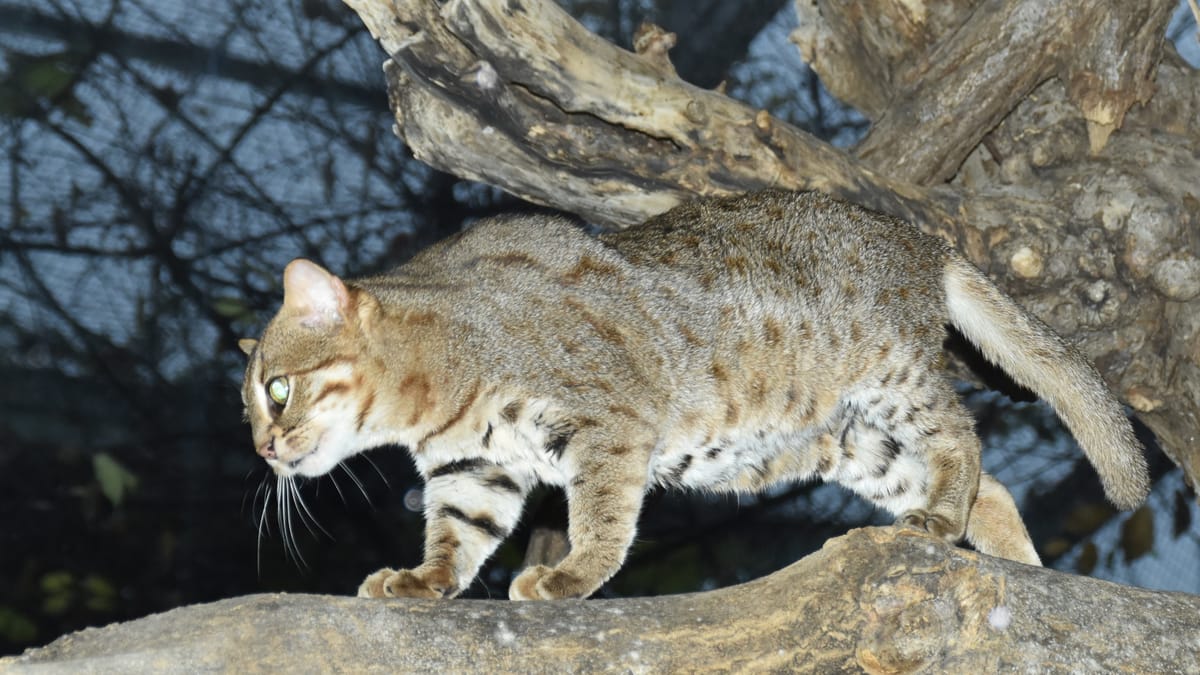
Image: NasserHalaweh · Wikimedia Commons (CC BY-SA 4.0)
The Cat Smaller Than Your Kitchen Cat: Rusty-Spotted Cat in Yala
Ask a Yala jeep full of tourists to name the park's cats and you'll get one answer: leopard. Maybe, if someone's done their homework, fishing cat. Almost nobody says rusty-spotted cat. Which is odd, because it's one of the smallest cats on the planet, and it lives here.
It won't be the star of your safari. It's nocturnal, secretive, and small enough to vanish into a single clump of lantana. But it's real, it's wild, and it belongs to Sri Lanka in a way few other animals do.
How Small Is Small
Adult rusty-spotted cats typically weigh somewhere in the range of one to one and a half kilograms. That's lighter than a bag of rice. Head to tail, most individuals would struggle to stretch across a car bonnet.
The coat is what gives the species its name: a grey-brown base scattered with rust-coloured blotches, running down the flanks in loose lines. In poor light, which is most of the time you'd realistically encounter one, it can look almost featureless, just a low shadow moving between grass stems.
We're not going to pretend this is an easy animal to spot. It isn't. Most guides who've worked in Yala for years count their rusty-spotted cat sightings on one hand. If you see one, treat it as a genuine wildlife event, not a checklist item.
Where It Actually Lives
The species range covers India, Nepal and Sri Lanka. That's the whole global distribution, which is narrower than most people assume for a cat this widespread in folklore and academic papers.
Within Sri Lanka, it favours dry forest and scrub, the same tangled, thorny habitat that makes up much of Yala's interior away from the tank-fed grasslands. Deciduous forest is its preferred cover, and that's precisely the type of habitat under the most pressure regionally, cleared for agriculture or fragmented by roads and settlements.
That habitat overlap matters. When people talk about Yala's ecological value, the conversation tends to gravitate toward elephants and leopards. The rusty-spotted cat is a reminder that the park's scrub and dry forest zones aren't just backdrop for the big-name animals. They're the entire world for species like this one.
If you want a sense of how varied that terrain gets, Yala Block 2: The Raw Reality Beyond the Menik Ganga covers the wilder, less-visited habitat where small, elusive species like this tend to persist longest.
Conservation Status, Honestly
Since 2016 the IUCN Red List has classified the rusty-spotted cat as Near Threatened. That's a step above Least Concern but below anything that would trigger emergency headlines, and it reflects the pressure on its habitat rather than a currently collapsing population. Deciduous forest loss and fragmentation across its range are the main drivers cited.
We haven't found a reliable, current population estimate specifically for Sri Lanka, and we're not going to invent one. Camera trap and survey data on this species tend to be sparse precisely because it's small, nocturnal and rarely triggers the sensors set for larger cats. If you see a confident number floating around online, treat it with some scepticism.
What we can say is that Yala's protected status directly benefits this species by default. Every hectare of scrub kept intact for leopards, sloth bears and elephants is also scrub kept intact for a cat most visitors have never heard of.
Why You Probably Won't See One, and What to Do About It
Nocturnal habits are the main obstacle. Standard Yala safaris run in the early morning and late afternoon, precisely because that's when the park is open to vehicles, not because that's when every animal is active. A cat like this does most of its hunting after dark, when the park is closed to jeeps.
Your best realistic odds come from quiet, slow-moving safaris in scrub-dense areas, ideally at dawn or dusk when nocturnal species are still transitioning to or from cover. Persistent, patient guides who spend time away from the main sighting clusters occasionally get lucky. For the same reasons, avoiding the crowded convoy sections of the park, discussed in Beating the Jeep Jam, tends to help with any elusive species, not just this one.
Mostly, though, this is a cat you go looking for with low expectations and a good pair of ears. If you get a sighting, you'll have seen something the vast majority of Yala visitors, guides included, never will.
Sources
- Rusty-spotted cat, Wikipedia: https://en.wikipedia.org/wiki/Rusty-spotted_cat
- IUCN Red List (species assessment context referenced via the above source)
Ready to see it for yourself?
Book a safari